
The race between exchanges, crypto platforms, and regulated broker-dealer market infrastructures to control tokenized securities
Abstract
Tokenized securities are moving from theory to implementation. In the past several months, major market institutions and crypto platforms have begun forming partnerships to bridge traditional equities with blockchain infrastructure.
Recent developments include exchange initiatives by Nasdaq and the New York Stock Exchange, alongside distribution partnerships with global crypto platforms. At the same time, crypto exchanges have already launched tokenized stock trading models reaching hundreds of millions of global users.
These moves confirm a critical shift: Wall Street is not competing with crypto — it is adopting crypto infrastructure.
However, the emerging market is not converging on a single model. Instead, four distinct architectural approaches are forming:
- Exchange-centric tokenization (Nasdaq)
- Hybrid exchange-crypto infrastructure (NYSE / ICE)
- Crypto exchange wrappers (Binance, Kraken, OKX)
- Clean-slate regulated broker-dealer infrastructure (Ohanae)
Understanding the differences between these models is essential for investors and market participants.
More importantly, it explains why many tokenization startups will fall into what we call the Tokenized Securities "Kill Zone" — and why a new infrastructure layer is emerging as the most strategically valuable position in digital capital markets.
Key Takeaways
- Tokenized securities markets are converging around four architectural models: exchange-centric tokenization, hybrid exchange–crypto markets, crypto-native wrapped tokens, and clean-slate regulated broker-dealer infrastructure.
- Traditional exchanges are integrating tokenization into existing market structure, preserving regulatory compliance but maintaining legacy settlement and clearing frameworks.
- Crypto platforms control global distribution and liquidity, but lack regulated infrastructure to support compliant securities markets.
- Many tokenization startups operate in what we call the "Tokenized Securities Kill Zone"—platforms that control neither distribution nor regulated market infrastructure.
- Historically, the highest-value companies in financial markets sit at the infrastructure layer, controlling settlement, custody, and market access.
- The long-term opportunity in tokenized securities may lie in the regulated infrastructure connecting global crypto liquidity with capital markets.
Wall Street + Crypto: A Structural Convergence
A recent post from Coinbase's Head of Stablecoin Ecosystem captured a growing industry realization:
"It is not Wall Street vs Crypto — it is Wall Street adopting crypto infrastructure."
Recent developments support this thesis:
- ICE / NYSE partnering with crypto platforms for tokenized equities
- Kraken building gateways between regulated equities and DeFi liquidity
- Binance working with tokenization platforms to relaunch tokenized stocks
- Coinbase launching commission-free equity trading
These moves are not isolated.
They represent the beginning of a structural redesign of capital markets infrastructure.
Three forces are driving this shift:
- 24×7 global liquidity
- Instant settlement (atomic delivery vs T+1 clearing)
- Programmable asset ownership
But while the direction is clear, the market is fragmenting into four different architectures.
The Four Competing Approaches to Tokenized Securities
1. Exchange-Centric Model
(Nasdaq + Kraken)
In this model, tokenization is added inside the existing exchange infrastructure.
Tokenized shares are issued as 1:1 digital twins of existing equities and remain integrated with traditional market structure.
Key characteristics:
- Tokens backed by real shares held in custody
- Clearing still occurs through DTCC infrastructure
- Trades remain subject to Reg NMS rules
- Settlement may still follow T+1 cycles
This approach preserves regulatory certainty and issuer governance, but it largely extends the existing market structure rather than replacing it.
Think of it as digitizing the current system rather than redesigning it.
2. Hybrid Exchange–Crypto Model
(NYSE / ICE + OKX)
The second model attempts a deeper transformation.
ICE is building a new digital exchange architecture where tokenized equities trade 24×7 and settle using stablecoin-based settlement.
Key features:
- On-chain settlement infrastructure
- 24×7 trading
- Integration with crypto distribution platforms
- Continued regulatory oversight under exchange rules
This model attempts to combine:
exchange regulation + crypto liquidity.
The partnership with OKX highlights the real strategic objective:
connect traditional equities to global crypto user bases.
3. Crypto Exchange Tokenization
(Binance, Kraken, OKX)
Crypto exchanges already operate the largest tokenized securities markets today.
These tokens typically represent equities held in custody vehicles or SPVs and trade globally on blockchain infrastructure.
Advantages:
- Global liquidity
- 24×5 trading
- Deep integration with DeFi
- Fractional ownership
However, these models face a major structural constraint:
They operate largely outside U.S. securities regulatory frameworks.
As tokenized securities mature, crypto exchanges will likely require partnerships with regulated financial infrastructure.
The Tokenized Securities "Kill Zone"
Between these models lies a dangerous structural trap.
Many tokenization startups are attempting to build platforms in the middle of the ecosystem — often through ATS venues, wrappers, or tokenization services.
But these platforms typically lack two things required for durable scale:
1. Distribution power
or
2. Regulated infrastructure
As the market consolidates, companies controlling those layers will dominate.
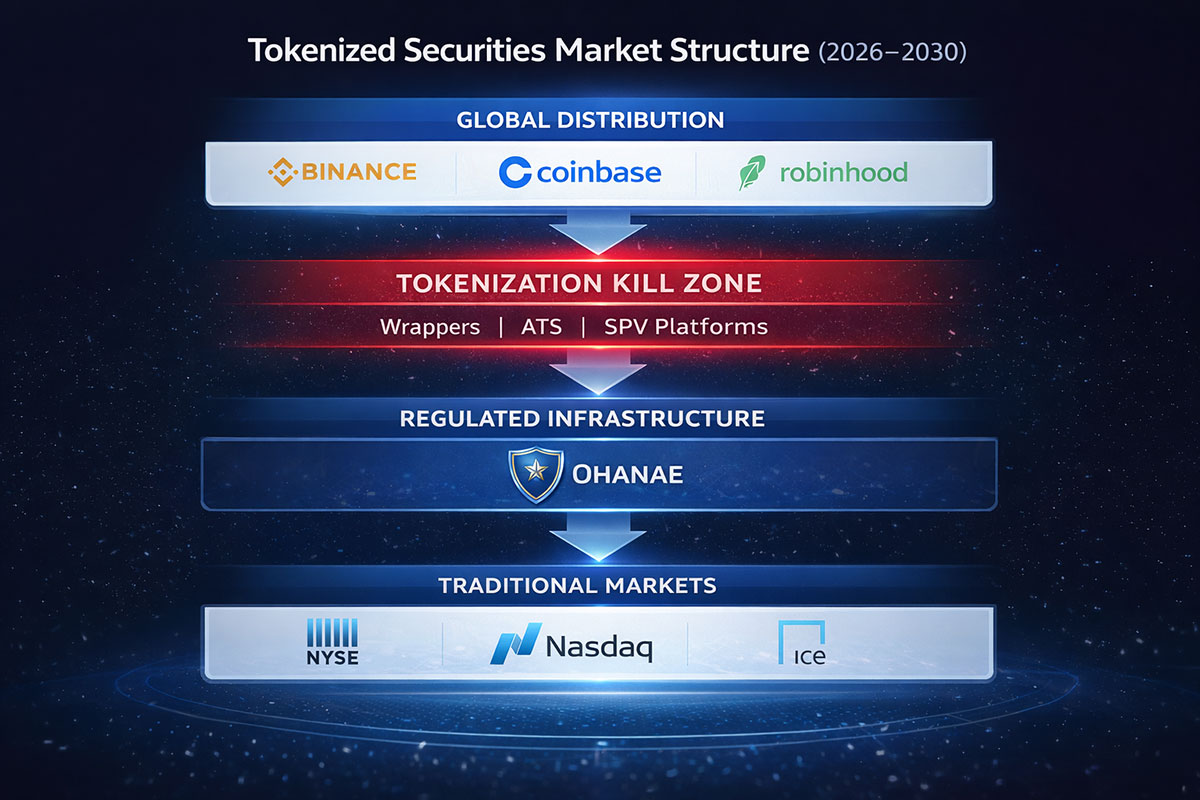
The ecosystem is increasingly organizing into three power centers:
- Distribution Platforms (Binance, Coinbase, Robinhood)
- Regulated Infrastructure (clearing, broker-dealer platforms)
- Public Market Institutions (NYSE, Nasdaq)
Platforms that sit between these layers without controlling either side risk becoming trapped in what we call the Tokenized Securities Kill Zone.
Historically, the highest-value companies in financial markets sit at the distribution layer or the infrastructure layer; platforms positioned between the two rarely capture durable economic rents.
Why the Clean-Slate Infrastructure Model Matters
The fourth architecture takes a fundamentally different approach.
Instead of adapting existing market infrastructure, it builds a new regulated broker-dealer system designed specifically for tokenized securities.
In this model:
- Companies issue native on-chain share classes
- Securities settle instantly using tokenized cash
- The blockchain serves as the official ownership ledger
- Trading occurs 24×7 with atomic settlement
This approach removes several structural constraints embedded in legacy markets:
- T+1 clearing cycles
- fragmented order routing
- leverage-driven settlement risk
- complex intermediary chains
Instead, securities move the same way digital assets move:
instantly, atomically, and continuously.
Where Value Accrues in Tokenized Markets
When new financial technologies emerge, the largest long-term economic value rarely accrues to the applications built on top of the system. It accrues to the infrastructure layer that controls settlement, custody, and market access.
History provides several examples:
- Clearinghouses became some of the most profitable institutions in financial markets.
- Exchanges such as the New York Stock Exchange and Nasdaq command premium valuations because they control trading infrastructure.
- Payment networks like Visa and Mastercard capture economic rents because they sit at the center of transaction settlement.
Tokenized securities markets are likely to follow a similar pattern.
Distribution platforms may control users. Exchanges will continue to anchor traditional capital markets.
But the regulated infrastructure connecting crypto liquidity with securities markets may become one of the most strategically valuable layers in the system.
The Strategic Power Map (2026–2030)
Over the next decade, tokenized capital markets are likely to stabilize around four structural layers:
Layer 1 — Global Distribution
- Binance
- Coinbase
- Robinhood
Layer 2 — Regulated Infrastructure
- Broker-dealer tokenized securities platforms
Layer 3 — Tokenization Platforms
- Asset issuance and DeFi integration
Layer 4 — Traditional Capital Markets
- NYSE
- Nasdaq
The most valuable position historically sits in Layer 2 — infrastructure.
Clearinghouses, exchanges, and settlement networks have historically captured the largest economic rents in financial markets.
The same dynamic is likely to emerge in tokenized securities.
The Real Question the Market Must Answer
The tokenization debate often focuses on which assets will become tokenized.
But that is not the strategic question.
The real question is:
Who controls the regulated infrastructure where those assets trade?
Distribution platforms control users.
Exchanges control traditional markets.
But the emerging tokenized ecosystem requires a new infrastructure layer capable of bridging both worlds.
The firms that successfully build that layer will define the next generation of capital markets.
Final Thought
Tokenization will not simply digitize equities.
It will reshape how securities move, settle, and trade globally.
The platforms that win this transition will not necessarily be those that tokenize the most assets.
They will be the ones that control the regulated infrastructure where those assets live.
The next two years will likely determine the architecture of tokenized capital markets.
The question is no longer whether securities will be tokenized — the question is who will control the infrastructure where they trade.
Regulated "Bridge" Market for Tokenized Equities
Ohanae's model is a clean-slate regulated broker-dealer market infrastructure. It issues native on-chain securities (new share classes under S-1, Reg A, Reg D, and Investment Contract Assets) alongside digital cash settlement, enabling real-time atomic 24×7 trading.
This market operates off-exchange (non–Reg-NMS) but remains fully compliant: the blockchain functions as the official ownership ledger and settlement layer. Liquidity is provided through a regulated dealer-principal and Automated Market Making (AMM) structure, creating a new market infrastructure layer that complements the traditional exchanges rather than replacing them.
Unlike SPV-based tokenized stock models, which rely on custodial wrappers around existing shares, the clean-slate approach issues native regulated securities directly on-chain. This architecture allows both U.S. and non-U.S. investors to participate in the market provided they complete broker-dealer KYC/AML onboarding and maintain a verified bank account capable of receiving wire transfers for cash settlement.
In effect, this creates a regulated bridge between global crypto liquidity and U.S. securities markets.
Disclaimer
Ohanae Securities LLC is a subsidiary of Ohanae, Inc. and member of FINRA/SIPC. Additional information about Ohanae Securities LLC can be found on BrokerCheck. Ohanae Securities LLC is in discussions with FINRA about exploring the expansion of business lines for the broker/dealer. Any statements regarding abilities of Ohanae Securities LLC are subject to FINRA approval and there are no guarantees FINRA will approve the broker/dealer's expansion.
Ohanae Securities is seeking approval to be a special purpose broker-dealer that is performing the full set of broker-dealer functions with respect to crypto asset securities – including maintaining custody of these assets – in a manner that addresses the unique attributes of digital asset securities and minimizes risk to investors and other market participants. If approved, Ohanae Securities will limit its business to crypto asset securities to isolate risk and having policies and procedures to, among other things, assess a given crypto asset security's distributed ledger technology and protect the private keys necessary to transfer the crypto asset security.