
Abstract
Tokenization has been one of the most discussed innovations in financial markets over the past decade. Early implementations focused on replicating traditional securities through blockchain wrappers and structured vehicles. While these models demonstrated demand for digital assets, they largely operated around existing market infrastructure rather than within it.
A new phase is emerging.
Recent regulatory signals—including legislative developments such as the GENIUS Act, the CLARITY Act, and the SEC's Project Crypto initiative—suggest that policymakers are beginning to address the deeper structural question: how securities markets themselves may evolve in a blockchain-native environment.
The conversation is shifting from tokenizing assets to modernizing market infrastructure.
The First Wave of Tokenization: Engineering Around the System
The first generation of tokenized securities projects focused primarily on economic exposure.
Platforms created SPVs, wrapped securities, or synthetic instruments that allowed investors to gain exposure to traditional assets through blockchain tokens.
This approach made sense.
Traditional securities infrastructure—clearing, settlement, broker-dealer rules, and exchange regulations—was never designed for decentralized networks.
So innovators built workarounds.
These models helped prove market demand. But they also revealed their limitations.
Wrappers replicate securities exposure.
They do not transform how markets work.
A Shift in Regulatory Thinking
A significant signal recently emerged from the U.S. Securities and Exchange Commission during remarks related to Project Crypto.
Commission leadership stated:
"Specifically, I would like to consider how issuers that want to tokenize their securities could work with a transfer agent or other tokenization agent to tokenize their securities so that they can be traded onchain in AMMs or other trading systems, environments, or platforms that offer decentralized liquidity."
(Full remarks available here: https://www.sec.gov/newsroom/speeches-statements/atkins-peirce-021826-number-go-down-other-schadenfreude)
This statement matters because it acknowledges something the industry has been waiting for:
Regulators are beginning to consider how securities themselves could exist natively on-chain—rather than merely being wrapped representations.
That shift opens the door to deeper reforms across several areas:
- Transfer agent modernization
- Broker-dealer custody frameworks
- Capital formation pathways for digital securities
- On-chain secondary liquidity environments
In other words, regulators are starting to examine market architecture, not just asset classification.
Why the National Market System Still Matters
Traditional exchanges such as the New York Stock Exchange and Nasdaq remain foundational institutions.
They will continue to serve listed companies, public markets, and the core infrastructure of U.S. capital formation.
Tokenization does not replace these markets.
But it may expand the ecosystem around them.
In particular, a new category is beginning to attract attention: regulated markets for tokenized and exempt securities operating outside the National Market System (NMS).
These environments could support:
- early-stage capital formation
- alternative liquidity models
- blockchain-native settlement
- programmable ownership and compliance
This is not about replacing existing exchanges.
It is about completing the capital formation lifecycle.
From Workarounds to Clean-Slate Infrastructure
The most important evolution in the tokenization landscape may be philosophical.
The first phase focused on adapting blockchain to legacy systems.
The next phase focuses on designing market infrastructure specifically for tokenized securities.
That means starting with several core principles:
- cash settlement rather than margin leverage
- real-time ownership tracking
- blockchain-native custody and recordkeeping
- programmable compliance
- continuous liquidity rather than discrete trading sessions
These design choices fundamentally change how markets operate.
Settlement cycles shrink from days to seconds.
Ownership records become transparent and automated.
Liquidity models evolve beyond traditional order books.
A New Layer of Market Infrastructure
This is where a new category of regulated platforms is beginning to emerge.
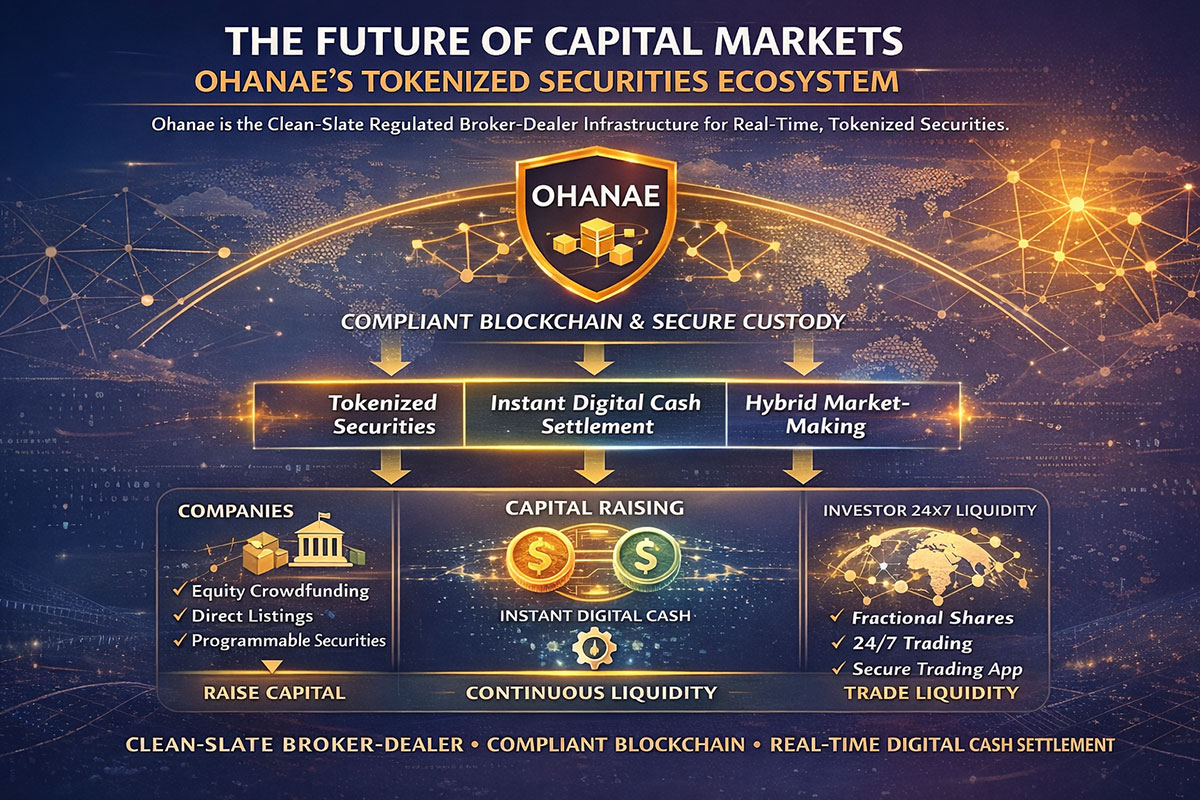
One example is Ohanae, a regulated broker-dealer infrastructure platform designed specifically for real-time tokenized securities markets.
NYSE. Nasdaq. Now, Ohanae.
Ohanae is building regulated infrastructure for tokenized securities that settle instantly with digital cash—bypassing traditional exchange settlement cycles.
The platform combines:
- broker-dealer custody
- compliant blockchain infrastructure
- automated ownership tracking
- continuous liquidity powered by automated market making
- 24x7 market access for investors
Its focus is not replacing public exchanges.
Instead, it aims to support tokenized and exempt issuers operating outside the National Market System, complementing existing market structure.
Why This Moment Matters
For years, tokenization lived in a regulatory gray zone.
Today, three forces are converging:
- Legislative clarity around digital assets
- Regulatory initiatives such as Project Crypto
- Institutional demand for blockchain-native capital markets
Together, they signal that tokenized securities may finally be moving from experimentation toward regulated market infrastructure.
If that transition occurs, the biggest opportunities will likely lie not in tokenizing individual assets—but in building the regulated systems where those assets trade.
The Road Ahead
Markets evolve slowly.
The New York Stock Exchange has operated for over two centuries. The Nasdaq revolutionized electronic trading decades ago.
Blockchain technology represents another potential step in that evolution.
But the real transformation will not come from wrappers or synthetic exposure.
It will come from new market infrastructure designed from the ground up for digital securities.
Confidence.
That’s the infrastructure the market has been waiting for.
Disclaimer
Ohanae Securities LLC is a subsidiary of Ohanae, Inc. and member of FINRA/SIPC. Additional information about Ohanae Securities LLC can be found on BrokerCheck. Ohanae Securities LLC is in discussions with FINRA about exploring the expansion of business lines for the broker/dealer. Any statements regarding abilities of Ohanae Securities LLC are subject to FINRA approval and there are no guarantees FINRA will approve the broker/dealer's expansion.
Ohanae Securities is seeking approval to be a special purpose broker-dealer that is performing the full set of broker-dealer functions with respect to crypto asset securities – including maintaining custody of these assets – in a manner that addresses the unique attributes of digital asset securities and minimizes risk to investors and other market participants. If approved, Ohanae Securities will limit its business to crypto asset securities to isolate risk and having policies and procedures to, among other things, assess a given crypto asset security's distributed ledger technology and protect the private keys necessary to transfer the crypto asset security.