
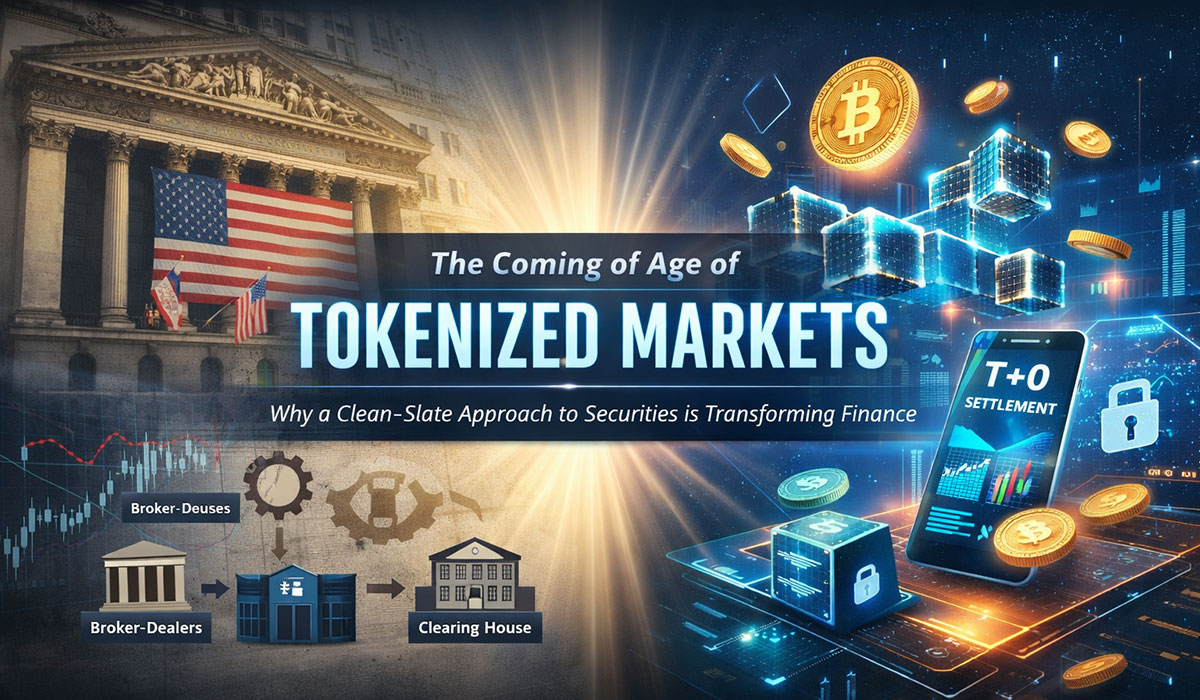
Abstract
For decades, public securities markets have been shaped by a layered structure of exchanges, broker-dealers, clearing agencies, and self-regulatory organizations—an architecture optimized for a paper-based, credit-driven world. While this framework has delivered scale and trust, it has also locked in settlement latency, operational complexity, and systemic risk that modern technology can no longer justify.
This blog explores why tokenization represents a coming-of-age moment for capital markets—and why incremental upgrades to legacy systems are insufficient. Rather than retrofitting blockchain into existing Reg NMS infrastructure, a clean-slate approach enables a fundamentally new market design: issuer-led tokenized securities, cash-only atomic settlement, 24×7 liquidity, and direct investor ownership under a regulated framework.
We examine how this evolution differs from ATS-based platforms and digital "twins" of legacy securities, and why off-exchange, non-Reg NMS tokenized markets can coexist with—rather than replace—NYSE and Nasdaq. The result is not disruption for its own sake, but the emergence of a parallel, compliant market structure purpose-built for real-time finance.
The future of markets is not about rebuilding yesterday’s exchanges on blockchain—it is about designing what markets should have been if built today.
For decades, public securities markets have been defined by complexity.
- Exchanges
- Broker-dealers
- Clearing agencies
- Alternative trading systems
Layer upon layer of intermediaries stand between investors and final ownership. This complexity is often mistaken for necessity—but in reality, it is the product of history, not optimal design.
Today, that is beginning to change.
Why Markets Look the Way They Do
The modern U.S. securities market was not built for real-time settlement, continuous trading, or digital ownership.
It was designed for:
- Paper certificates
- Manual reconciliation
- Batch processing
- Credit-based settlement
In this environment, intermediaries were essential.
- Exchanges centralized liquidity and price discovery.
- Broker-dealers managed customer relationships and credit exposure.
- Clearinghouses absorbed systemic risk created by delayed settlement.
Regulation NMS later formalized this structure to preserve fairness, competition, and investor protection—while allowing innovation at the venue level through Alternative Trading Systems (ATS).
The result is the market we know today: robust, trusted, but structurally complex.
The Hidden Assumption Behind Reg NMS
At the heart of Reg NMS and the broader market structure lies an implicit assumption:
Trades do not settle instantly.
Because settlement is delayed, markets must rely on:
- Margin
- Securities lending
- Rehypothecation
- Central clearing guarantees
This credit-based system requires intermediaries to manage risk during the settlement window. The structure works—but it is not simple, and it is not real time.
What Changed: Real-Time Settlement Became Possible
Blockchain technology introduced something fundamentally new:
- Atomic delivery versus payment
- Cryptographic ownership records
- Programmable compliance
- Continuous, auditable settlement
For the first time, finality no longer requires intermediated credit.
When settlement is instantaneous and cash-only:
- Clearing risk disappears
- Many reconciliation layers collapse
- Ownership can be updated in real time
This does not make legacy markets obsolete—but it makes a clean-slate design viable.
Why ATS-Based Tokenization Isn't Enough
Many early tokenization efforts have focused on adapting existing market structures:
- Tokenized securities traded on ATSs
- Legacy settlement models wrapped in blockchain rails
- Liquidity still dependent on venue-based matching
These approaches represent important progress—but they do not fundamentally change market architecture. They remain constrained by the same assumptions that shaped Reg NMS.
For publicly listed securities, this means investors gain little advantage over trading on traditional exchanges.
The Clean-Slate Approach: A Parallel Market, not a Replacement
A clean-slate approach does not attempt to replace NYSE, Nasdaq, or DTC.
Instead, it asks a different question:
What would a securities market look like if it were designed today, assuming instant settlement is possible?
The answer looks very different:
- Cash-only trading
- Atomic settlement (T+0)
- Direct ownership and custody
- 24×7 availability
- Programmable corporate actions
Importantly, this model works outside Reg NMS—not because it avoids regulation, but because it eliminates the credit risk Reg NMS was built to manage.
Issuer-Led Tokenized Shares: A Natural Bridge
For public companies, the clean-slate path is not forced migration—it is choice.
Issuers can:
- Maintain their existing exchange-listed shares
- Create a separate, fully registered tokenized class
- Offer shareholders an opt-in alternative market
This preserves investor protection and corporate governance while enabling innovation where it actually matters: settlement, ownership, and market efficiency.
Why This Moment Matters
Regulators are increasingly recognizing that:
- Real-time settlement changes the risk equation
- Cash-only markets reduce systemic fragility
- New structures can coexist with legacy infrastructure
Initiatives like the SEC's Project Crypto reflect this shift—from regulation by enforcement toward rules that acknowledge technological reality.
The question is no longer if markets can evolve, but how.
The Path Forward
The future of capital markets will not be built by tearing down existing institutions.
It will be built by:
- Complementing legacy exchanges
- Offering parallel, opt-in alternatives
- Designing markets around finality, not leverage
This is the coming of age of tokenized markets.
Not as a speculative experiment—but as a clean-slate rethinking of how securities can be issued, traded, settled, and owned in a digital world.
Final Thought
Complexity was once the price of safety.
Today, safety can be achieved through simplicity.
The next generation of markets will be defined not by how many intermediaries they require—but by how many they no longer need.
NYSE. Nasdaq. Now, Ohanae.
Ohanae is a regulated platform for tokenized securities that settles instantly with digital cash—bypassing traditional exchanges.
We give investors 24x7 liquidity and help companies raise capital through equity crowdfunding.
Our platform combines secure custody, a compliant blockchain, automated ownership tracking, and continuous liquidity powered by hybrid market-making.
In short: we're building the regulated infrastructure the market has been waiting for.
Confidence. That's Ohanae.
Disclaimer
Ohanae Securities LLC is a subsidiary of Ohanae, Inc. and member of FINRA/SIPC. Additional information about Ohanae Securities LLC can be found on BrokerCheck. Ohanae Securities LLC is in discussions with FINRA about exploring the expansion of business lines for the broker/dealer. Any statements regarding abilities of Ohanae Securities LLC are subject to FINRA approval and there are no guarantees FINRA will approve the broker/dealer's expansion.
Ohanae Securities is seeking approval to be a special purpose broker-dealer that is performing the full set of broker-dealer functions with respect to crypto asset securities – including maintaining custody of these assets – in a manner that addresses the unique attributes of digital asset securities and minimizes risk to investors and other market participants. If approved, Ohanae Securities will limit its business to crypto asset securities to isolate risk and having policies and procedures to, among other things, assess a given crypto asset security's distributed ledger technology and protect the private keys necessary to transfer the crypto asset security.