
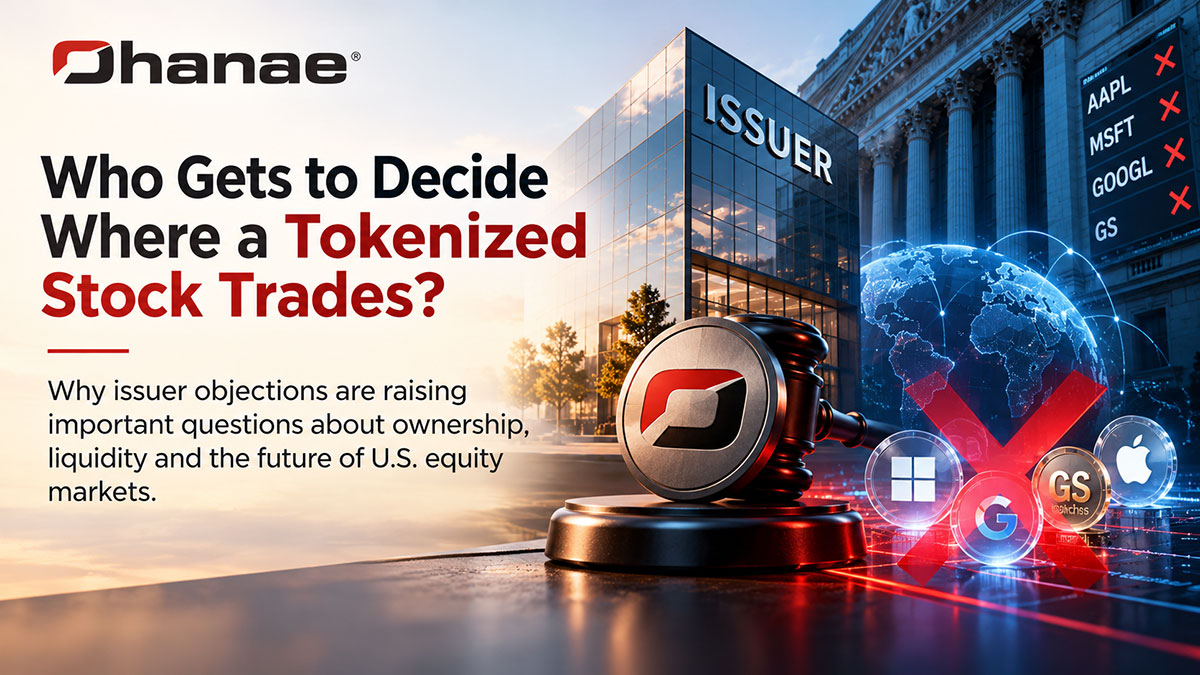
Who Gets to Decide Where a Tokenized Stock Trades?
Why issuer objections are raising important questions about ownership, liquidity and the future of U.S. equity markets
A new chapter in U.S. securities tokenization is revealing an important question: when a public company’s shares are represented by blockchain tokens, who gets to decide whether those tokens can trade?
On October 20, CoinDesk reported that Microsoft, Alphabet and Goldman Sachs were among seven additional issuers objecting to tokenized versions of their shares trading on OKXICE, the planned venue associated with OKX and Intercontinental Exchange. The disclosed objection count reached 16. The latest notice did not explain the companies’ individual reasons for objecting.
The news does not establish that these companies oppose blockchain technology or tokenization generally. It does, however, illuminate how a new market structure must address the interests of issuers, investors and intermediaries.
Why can an issuer object to a tokenized stock?
In conventional public equity markets, a company generally does not approve each secondary-market trade in its outstanding shares. Investors buy and sell through regulated market intermediaries, subject to applicable securities rules.
Tokenized stock trading under the SEC’s September 2026 Innovation Exemption introduces a more specific process. Before a Tokenized Securities Venue (”TSV”) offers a tokenized National Market System (“NMS”) stock created by an unaffiliated third party, it must notify the issuer and provide an opportunity to object. The SEC staff’s October 20 FAQ explains that a timely issuer objection prevents that TSV from making the affected tokenized stock available for trading under the exemption.
This is a condition of that particular temporary exemption—not a blanket rule giving every issuer control over all secondary trading of its conventional shares, nor a conclusion about every possible tokenization structure.
What does an investor actually own?
A token appearing in a digital wallet is not, by itself, enough to explain the investor’s legal position. The critical questions are what security the token represents, who holds any underlying shares, what records establish ownership, and how shareholder rights are delivered.
For the SEC’s TSV framework, the venue must verify that the tokenized NMS stock provides holders the same rights and privileges as equivalent traditional shares. That raises practical questions about dividends, voting, corporate actions, transfers, custody, and reconciliation between tokens and underlying stock.
A sound tokenization model should be able to answer those questions in plain English before asking investors to trade.
Why might issuers hesitate?
New trading arrangements can raise legitimate questions about pricing transparency, market fragmentation, shareholder communications, custody, operational resilience and investor protection. An issuer may also prefer to understand how the new venue interacts with established U.S. equity markets before participating.
These are possible considerations, not verified explanations for any particular company’s objection. An objection to one venue should not be confused with opposition to all issuer-sponsored or third-party tokenization models.
Two distinct paths to blockchain securities
One path begins with the issuer. An operating company can authorize a blockchain-native security or share class, with ownership rights and records designed for that issuance. In an appropriately structured system, the blockchain can serve as the authoritative ownership ledger, supported by the appointed transfer agent and regulated intermediaries.
Another path begins with an existing publicly traded NMS stock. A third party creates a tokenized representation of that stock while the underlying share continues to exist within the established equity market and custody system. This requires careful backing, rights, recordkeeping and reconciliation arrangements. Under the current TSV exemption, the issuer-notice and objection conditions may apply.
These approaches are not interchangeable. Their legal structures, issuer roles, custody arrangements and trading requirements differ.
The real test: trustworthy markets and usable liquidity
Tokenization may enable more programmable ownership records and faster, potentially atomic settlement. But technology alone does not create a good securities market. Investors still need clarity about what they own, reliable custody, transparent and competitive prices, and the ability to trade when they need liquidity.
For tokenized NMS stocks, reference to established U.S. equity prices—including the National Best Bid and Offer (“NBBO”) during applicable trading sessions—may help market participants assess execution quality. Pricing outside regular market hours presents additional challenges, particularly when the underlying stock market is closed. A blockchain trading venue must confront those realities rather than assume a token automatically creates liquidity.
How Ohanae approaches the opportunity
Ohanae is developing regulated infrastructure for two complementary securities markets. Its core focus is issuer-sponsored blockchain-native securities outside Regulation NMS. Separately, Ohanae is exploring a market for eligible tokenized U.S. public stocks, subject to establishing the necessary regulatory permissions and operating controls.
Ohanae’s FINRA-member carrying, self-clearing broker-dealer and SEC-registered transfer-agent capabilities provide an important foundation for its approved activities. They do not, by themselves, constitute approval to operate the proposed tokenized NMS-stock service.
Our guiding principle is that custody, ownership records, trading, clearing and settlement should work together—and that sustainable liquidity and investor confidence matter more than tokenization as an end in itself.
The question that will shape adoption
The current issuer objections are not a final verdict on tokenized equities. They are evidence that market design, legal rights and trust matter. Different issuers may reach different decisions as the technology, safeguards and regulatory framework evolve.
The future of tokenized securities will depend not simply on which blockchain is used, but on whether the market structure earns the confidence of issuers and investors.
Sources and further reading
SEC, Innovation Exemption press release, Sept. 17, 2026
SEC Division of Trading and Markets, Innovation Exemption FAQ, Oct. 20, 2026
Federal Register, SEC exemptive order, Release 34-106402
Educational commentary only. Not investment or legal advice. The SEC staff FAQ expresses staff views, not a Commission rule. Ohanae’s proposed tokenized NMS-stock activities remain subject to regulatory review and applicable approvals.