
TOKENIZATION IS NOT THE SAME AS MARKET INNOVATION
Why the future of securities markets is about better trading, custody and settlement—not simply digital copies of stocks
Wall Street’s tokenization initiatives are accelerating. The New York Stock Exchange is developing a digital alternative trading system (“ATS”) that will combine its Pillar matching technology with blockchain-based clearing and settlement. Nasdaq has received SEC approval for a model that accommodates tokenized shares in its existing order book. And the Depository Trust Company (“DTC”) has launched a service for tokenized representations of securities already in its custody. [1–3]
These are important developments. But they raise a simple question: What actually improves for investors when an existing share is represented by a token?
The difference between a digital twin and a better market
A digital twin can represent rights in an existing security on a blockchain. Its value depends on what that representation enables. If the share still moves through the same trading and custody processes, tokenization may add another technology layer, along with cybersecurity, reconciliation and operational costs.
That does not mean digital twins lack value. They may enable programmable transfers, more mobile collateral, additional distribution channels and more efficient post-trade workflows. DTC specifically identifies collateral mobility and capital efficiency as objectives of its tokenization service. [3]
The meaningful question is not whether a security has been tokenized. It is whether tokenization removes friction, enables a useful new service or makes the market more accessible.
Why NYSE, Nasdaq and DTC are taking different paths
The institutions do different jobs. Exchanges organize trading; DTC provides central custody and settlement infrastructure; transfer agents maintain issuer-side ownership records. Each can incorporate blockchain without abandoning its established responsibilities.
NYSE is designing a new venue with 24x7 trading ambitions, subject to regulatory approval, while retaining order matching as a central function. Nasdaq’s approved approach keeps tokenized and conventional shares in a common order book. DTC has launched tokenized representations of eligible assets that remain in its custody framework. [1–3]
These initiatives may complement one another, but none automatically proves that investors will receive deeper liquidity, tighter spreads or lower total costs. Those outcomes depend on what changes in the actual transaction.
A different innovation: permissioned automated market making
A conventional order book matches buyers and sellers. An automated market maker (“AMM”) instead lets eligible participants transact against a funded liquidity pool under programmed pricing and execution rules. In a properly structured system, this can make liquidity available beyond conventional market hours.
On September 17, 2026, the SEC granted temporary, conditional relief for qualifying Tokenized Securities Venues (“TSVs”) to trade tokenized National Market System (“NMS”) stocks through permissioned AMM liquidity pools. The order also provides separate conditional relief for certain proprietary liquidity providers, called Covered Firms. [4]
This is a different experiment from simply recording existing stock positions on a blockchain: it tests a new method of providing liquidity. Yet continuous quote availability is not the same as good liquidity. Spreads, execution quality, market depth, stale off-hours reference prices and inventory risk still matter.
Ohanae: building on an existing regulated AMM foundation
Ohanae’s approach begins with regulated securities-market operations, not token issuance alone. Ohanae Securities LLC is a FINRA-member carrying and self-clearing broker-dealer. Its FINRA-authorized business model includes AMM-facilitated trading of eligible non-NMS crypto asset securities using Crypto Security/OUSD pairs.
The proposed next step is to extend the integrated experience to eligible tokenized NMS public stocks under the SEC’s Innovation Exemption and any additional applicable authorizations. For these stocks, the underlying shares would remain with a DTC-linked custodian, while Ohanae Securities would control customer entitlement records and token minting and redemption under the proposed arrangements. The intended paired settlement asset is OUSD.
This is an additive strategy—not an assertion that existing FINRA permission for non-NMS crypto securities automatically covers tokenized NMS shares. The proposed TSV, OUSD treatment and affiliated liquidity-provider activities are subject to the relevant SEC and FINRA requirements.
One regulated infrastructure. Two complementary securities markets.
Ohanae’s long-term vision is one customer marketplace serving two securities categories: issuer-sponsored blockchain-native non-NMS securities, and eligible tokenized NMS public stocks. These categories have different legal requirements, but they can potentially share carefully designed operational capabilities: verified customer access, compliance monitoring, regulated carrying and custody, risk controls, and common AMM technology.
The non-NMS market can connect capital formation, transfer-agency services and secondary trading for securities designed to be blockchain-native. The proposed tokenized NMS market could bring an additional form of liquidity to existing listed stocks. These are complementary commercial opportunities, not identical legal regimes or one undifferentiated liquidity pool.
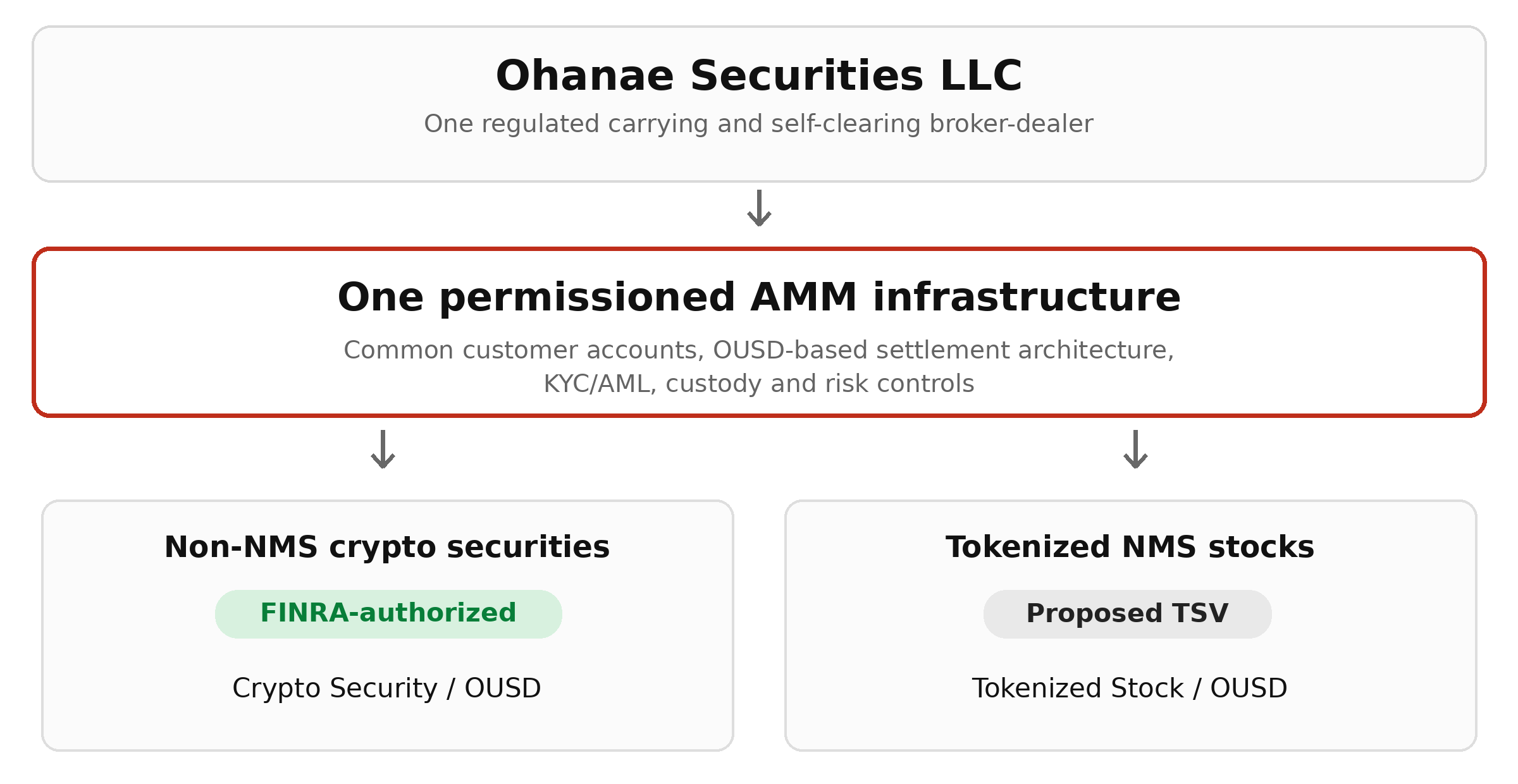
Illustrative target architecture. Existing non-NMS activities are distinguished from proposed NMS-stock TSV activities, which remain subject to applicable regulatory requirements.
Peace of Mind starts with carrying and custody
A blockchain can record a transaction. It does not, by itself, identify who is accountable for the investor’s securities, cash claims, legal rights or customer-asset protection.
That is why Ohanae emphasizes Peace of Mind: regulated carrying and custody, controlled creation and redemption of tokens, clear rights in the underlying securities, customer-asset segregation, reconciliation, and KYC/AML supervision. Ohanae, Inc. is also an SEC-registered transfer agent.
In the proposed NMS-stock model, proprietary AMM liquidity would be supplied using the affiliate’s own capital—not cash held for customers in the broker-dealer’s Special Reserve Account (“SRA”). The legal and operational controls are as important as the smart contracts themselves. For investors, Peace of Mind means knowing which regulated institution is responsible for carrying their securities, maintaining custody arrangements, protecting customer assets and ensuring that digital tokens represent clearly defined legal rights.
Beyond the SEC’s five-year experiment
The Innovation Exemption currently runs through September 17, 2031. SEC leadership has described it as a bridge toward durable rulemaking—not as a permanent authorization. [4-5]
For Ohanae, the five-year Innovation Exemption represents an opportunity to extend an existing FINRA-authorized non-NMS AMM infrastructure into tokenized public stocks, while helping demonstrate the merits of a permanent regulatory framework.
Ohanae’s long-term objective is to work with the SEC and FINRA toward durable authorization for tokenized NMS-stock AMM trading and associated liquidity provision well before September 2031. The SEC has expressly invited consideration of making the TSV and Covered Firm exemptions permanent.
This approach builds on Ohanae’s existing regulated non-NMS securities business, while recognizing that continued NMS-stock operations beyond the exemption will require applicable regulatory authority.
The broader opportunity is to develop market infrastructure that can responsibly support both securities categories over the long term, with different regulatory safeguards where the law requires them.
The real measure of innovation
The success of securities tokenization should be judged by measurable outcomes: better access to execution, competitive prices, lower lifecycle costs, sound custody arrangements, strong investor protections and reliable settlement—not by the number of tokens created.
NYSE, Nasdaq and DTC are bringing blockchain into major parts of the existing market. Ohanae is pursuing another complementary direction: applying integrated, regulated carrying, custody and AMM technology across two securities markets.
NYSE. Nasdaq. Now, Ohanae.
One regulated infrastructure. Two complementary securities markets.
Sources and editorial notes
[1] Ava Labs, “Avalanche to Serve as Core Ledger Technology for Clearing and Settlement of NYSE-affiliated Upcoming Tokenized Securities Platform,” November 9, 2026. https://www.prnewswire.com/news-releases/avalanche-to-serve-as-core-ledger-technology-for-clearing-and-settlement-of-nyse-affiliated-upcoming-tokenized-securities-platform-302932803.html
[2] SEC, SR-NASDAQ-2025-072, approval issued March 18, 2026. https://www.sec.gov/rules-regulations/self-regulatory-organization-rulemaking/sr-nasdaq-2025-072
[3] DTCC, “DTCC Tokenization Service Goes Live,” October 28, 2026. https://www.dtcc.com/press-releases/2026/dtcc-tokenization-service-goes-live
[4] SEC, “SEC Issues ‘Innovation Exemption’ to Facilitate the Trading of Tokenized NMS Stock,” September 17, 2026. https://www.sec.gov/newsroom/press-releases/2026-90-sec-issues-innovation-exemption-facilitate-trading-tokenized-nms-stock-request-comment
[5] SEC Chairman Paul S. Atkins, “Statement on the Innovation Exemption: A Bridge Toward Durable Rulemaking,” September 17, 2026. https://www.sec.gov/newsroom/speeches-statements/atkins-innovation-exemption-bridge-toward-durable-rulemaking-091726
Editorial disclosure: Descriptions of Ohanae’s existing FINRA-authorized non-NMS AMM business are based on company-provided information. All tokenized NMS-stock activities described are proposed and subject to the applicable conditions and regulatory processes. This article is educational commentary, not an offer to buy or sell securities or investment advice.