
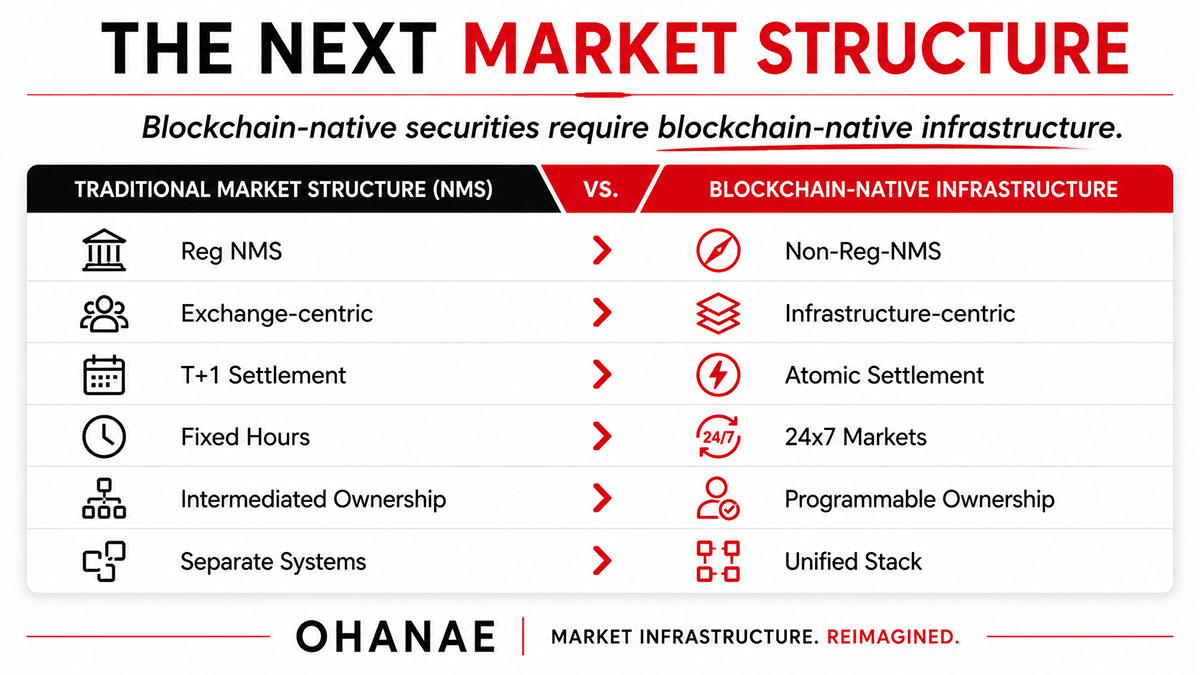
The Next Market Structure
Blockchain-native securities require blockchain-native infrastructure
For years, the digital asset industry focused on tokenization.
Tokenized stocks.
Tokenized funds.
Tokenized real-world assets.
But the conversation is now evolving far beyond tokenization itself.
Pending the SEC’s proposed innovation exemption framework for tokenized securities, the industry may be entering the early stages of a new category of capital markets infrastructure:
blockchain-native securities markets.
This is a fundamentally different conversation.
The question is no longer:
“Can securities be tokenized?”
The question is becoming:
“What should blockchain-native capital markets look like?”
The Industry Is Moving Beyond Synthetic Structures
Recent industry discussions surrounding tokenized equities have highlighted growing focus on:
- ownership integrity,
- shareholder rights,
- regulated custody,
- transfer controls,
- and compliant market infrastructure.
This evolution is important
Because tokenizing a stock is easy.
Building:
- regulated custody,
- integrated transfer infrastructure,
- compliant settlement,
- shareholder servicing,
- and ownership integrity
is significantly harder.
And increasingly, the market appears to be recognizing that distinction.
The Next Opportunity May Not Be Traditional Public Equities
Most tokenized stock discussions today still focus on:
- wrapper tokens,
- synthetic exposure products,
- or bringing traditional equities onto crypto rails.
But the larger opportunity may be:
blockchain-native capital formation.
That includes:
- Investment Contract Asset (ICA) offerings,
- Reg A blockchain-native issuances,
- S-1 registered issuer-sponsored secondary markets,
- programmable ownership,
- and 24x7 liquidity environments designed for the digital era.
This is not simply another trading venue.
It is the emergence of a new market structure category.
Traditional Market Structures Were Built For A Different Era
Traditional exchanges and ATSs operate within the existing Reg NMS framework.
That infrastructure was designed around:
- centralized exchanges,
- fragmented systems,
- intermediated ownership,
- limited market hours,
- and delayed settlement cycles.
Blockchain-native securities introduce new capabilities:
- instant atomic settlement,
- programmable ownership,
- integrated transfer infrastructure,
- continuous liquidity,
- and real-time shareholder records.
These capabilities may not fit neatly inside traditional market structures.
And increasingly, regulators appear willing to explore that reality.
Why Infrastructure Matters
The future winners in blockchain-native securities will likely not be determined solely by:
- token issuance,
- trading interfaces,
- or speculative liquidity.
The long-term differentiators may become:
- regulated custody,
- ownership integrity,
- transfer agency,
- compliant settlement,
- and integrated market infrastructure.
Because eventually institutions will ask:
“Which platforms provide real regulated ownership infrastructure?”
That question matters far more than:
“Which platform can create a token?”
The Next Evolution Of Digital Markets
Today, much of crypto trading remains largely narrative-driven.
Many crypto assets:
- lack ownership rights,
- lack disclosure standards,
- and lack fundamental valuation anchors.
But crypto asset securities introduce something fundamentally different:
issuer fundamentals.
Revenue.
Cash flow.
Governance.
Ownership rights.
Disclosure obligations.
Shareholder economics.
This could eventually create a new category of investor:
blockchain-native equity investors.
Investors who value:
- blockchain settlement,
- programmable ownership,
- continuous liquidity,
- and issuer fundamentals simultaneously.
That category does not fully exist yet at scale.
But the infrastructure foundation is beginning to form.
A New Category of Capital Markets Infrastructure
The convergence now taking place is significant:
- tokenized securities frameworks,
- blockchain settlement discussions,
- digital cash infrastructure,
- institutional digital asset adoption,
- and emerging legislation such as the CLARITY Act.
Together, these developments suggest the market may be evolving beyond:
digital assets
toward:
blockchain-native capital markets.
That is a significantly larger opportunity.
Ohanae’s Position
On May 26, 2026, FINRA authorized the expansion of Ohanae Securities’ business activities to include custody, clearing, settlement, and carrying of crypto asset securities under the core broker-dealer framework.
This authorization establishes a regulated foundation for blockchain-native securities infrastructure designed for the digital era.
Importantly, Ohanae’s architecture was not designed around:
- synthetic public equity tokens,
- unauthorized stock wrappers,
- or fragmented ownership structures.
The focus has always been:
- regulated ownership infrastructure,
- blockchain-native capital formation,
- integrated custody and settlement,
- and issuer-sponsored secondary markets.
Because blockchain-native securities require blockchain-native infrastructure.
Category Of One
The future of capital markets may not be defined by:
- traditional finance versus crypto,
- or exchanges versus blockchain.
The larger transformation may be:
the evolution of market infrastructure itself.
The industry spent years focused on tokenization.
The next phase may be about building the infrastructure layer for blockchain-native capital markets.
NYSE. Nasdaq. Now, Ohanae.