

Why the SEC's approval validates tokenization—but also exposes the limits of legacy market infrastructure
Abstract
The U.S. Securities and Exchange Commission has approved Nasdaq's proposal to enable trading of securities in tokenized form. While widely seen as a breakthrough, the structure reveals a critical reality: tokenization is being integrated within the existing market system—not replacing it. Tokenized shares must remain fully fungible with traditional securities, settle through the Depository Trust Company (DTC), and operate under the same rules, timelines, and infrastructure. This is a meaningful step forward—but not a structural transformation. The implication is clear: the future of tokenized securities will not be defined by digitization alone, but by the emergence of new market infrastructure designed for blockchain-native assets.
A Structural Shift in Tokenized Securities Markets
The SEC has formally approved Nasdaq's rule change to enable tokenized securities trading.
The full document can be downloaded here: https://www.sec.gov/files/rules/sro/nasdaq/2026/34-105047.pdf
At first glance, this appears to be a major leap toward blockchain-based capital markets.
It is.
But it is also something else entirely.
1. What Nasdaq's Model Actually Does
Under the approved framework:
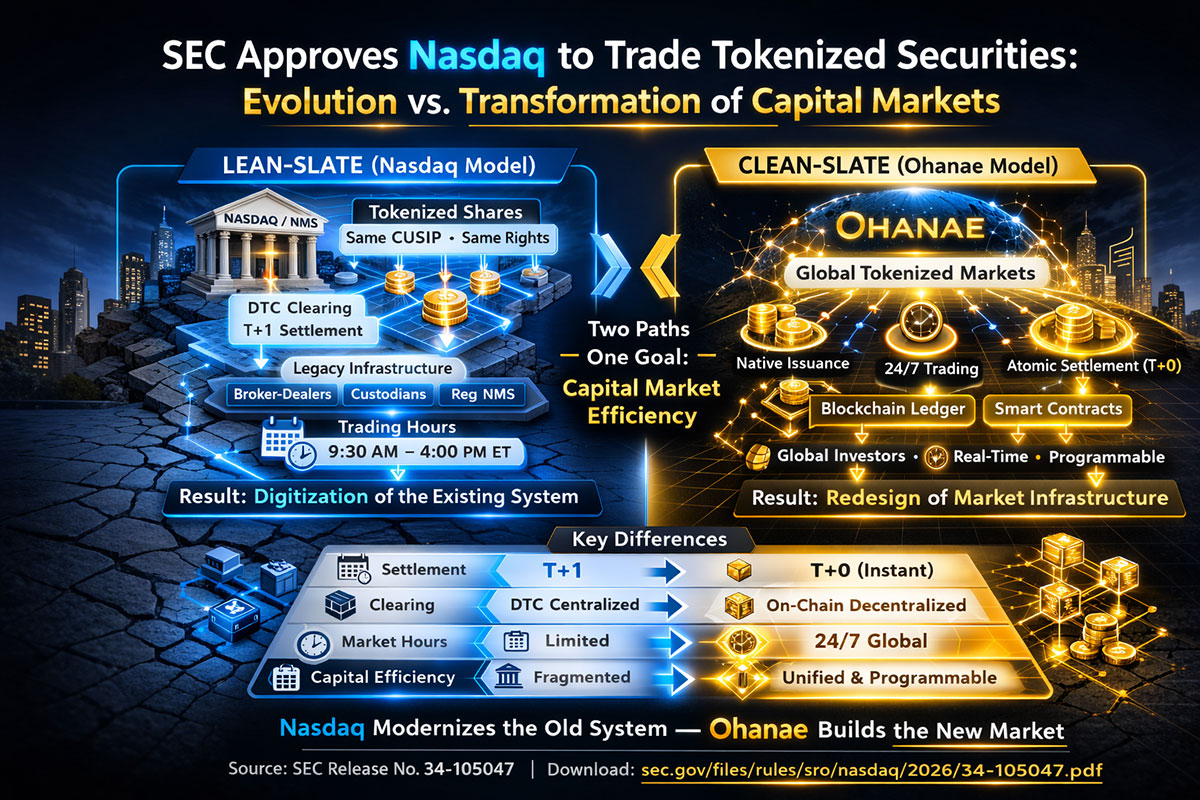
- Tokenized securities are fully interchangeable with traditional shares
- They share the same CUSIP, ticker, and shareholder rights
- They trade on the same order book with identical execution priority
- Clearing and settlement are handled by DTC infrastructure
- Settlement remains T+1
In short:
Tokenization is introduced—but the market structure remains unchanged
2. Tokenization Without Transformation
This is the critical insight:
Nasdaq is not building a new market.
It is digitizing the existing one.
- No change to clearing model
- No change to settlement cycle
- No change to trading hours or capital efficiency
Even in tokenized form, securities still move through:
- broker-dealers
- central clearing
- post-trade netting
3. Why This Matters
This approval draws a clear line between two approaches:
Approach 1: Tokenization Within the System (Nasdaq)
- Token = representation of existing shares
- Infrastructure = unchanged
- Outcome = efficiency gains at the margin
Approach 2: Tokenization as Market Redesign
- Token = native security
- Blockchain = primary ledger
- Settlement = atomic and real-time
- Outcome = structural change
4. The SEC's Position Is Clear
The SEC is signaling:
Innovation is allowed—but must operate within existing regulatory protections.
This explains why:
- tokenized shares must retain identical rights
- market surveillance remains unchanged
- tokenization cannot bypass clearing and custody layers
5. What This Means for the Market
The industry is now entering a two-track evolution:
Track 1 — Institutional Continuity
- Led by exchanges
- Built on existing infrastructure
- Optimized for compliance and stability
Track 2 — Infrastructure Innovation
- Built from first principles
- Designed for real-time settlement
- Focused on capital efficiency and global access
Final Insight
The SEC didn't just approve tokenization.
It defined its boundaries.
Tokenization alone does not change market structure. Infrastructure does.
Disclaimer
Ohanae Securities LLC is a subsidiary of Ohanae, Inc. and a member of the Financial Industry Regulatory Authority and Securities Investor Protection Corporation (FINRA/SIPC). Additional information about Ohanae Securities LLC is available on BrokerCheck.
Ohanae Securities LLC is currently in discussions with FINRA regarding the potential expansion of its business lines, which may include custody and related services for crypto asset securities. Any statements regarding the capabilities or services of Ohanae Securities LLC are subject to regulatory approval, and there can be no assurance that such approvals will be obtained.
Ohanae Securities LLC intends to operate in a manner that addresses the unique characteristics of crypto asset securities, including maintaining robust policies and procedures for custody, safeguarding of private keys, and evaluation of distributed ledger technology. The firm’s approach is designed to support crypto asset securities that may not efficiently operate within the traditional National Market System (NMS). Subject to applicable regulatory approvals, Ohanae Securities LLC may expand its activities to include additional services that may be conducted in a dealer-principal capacity, with the objective of protecting investors and maintaining market integrity.