
Abstract
The transition to tokenized securities is accelerating, driven by institutional adoption and regulatory momentum. However, the industry remains disproportionately focused on the technology layer—issuance, tokenization, and asset packaging—while the fundamental challenge of market structure remains unresolved. Tokenization alone does not create liquidity, price discovery, or efficient capital markets.
Recent market developments validate this shift. Figure Technologies' $150 million secondary offering of blockchain-based shares demonstrates that the path forward is not the tokenization of existing public equities, but the creation of native on-chain securities and parallel share class structures. These securities are issued directly on blockchain, operate outside traditional exchange infrastructure, and enable real-time settlement—without requiring migration of existing shareholders.
This marks the emergence of a new category: on-chain equities—a market defined not by tokenization, but by redesigned infrastructure.
Beyond Tokenization: The Real Problem
For the past several years, the financial industry has been focused on a single idea:
Put assets on blockchain.
This has led to the rise of:
- Tokenization platforms
- Asset wrappers
- Structured digital products
But something critical is missing.
Tokenization does not solve:
- Fragmented liquidity
- Limited trading hours
- Delayed settlement
- Intermediated ownership
In other words:
Tokenization digitizes assets. It does not rebuild markets.
The Shift Is Already Happening
This is no longer theoretical.
Figure Technologies' recent $150 million blockchain equity offering signals a clear directional shift:
- Securities are issued natively on-chain
- Structured as parallel share classes
- Enable real-time settlement
- Operate outside traditional exchange infrastructure
Importantly:
These securities are not migrated from existing exchanges. They are newly created for a new market structure.
This is the inflection point.
From Tokenized Securities to On-Chain Equities
We are now entering the next phase:
Phase 1: Tokenization
- Digital wrappers of existing assets
- Still reliant on legacy infrastructure
Phase 2: On-Chain Equities
- Native issuance
- Parallel capital structures
- Blockchain as the system of record
- Continuous, global markets
The difference is profound.
Tokenization upgrades assets. On-chain equities redefine the market itself.
Two Market Structures Are Emerging
The industry is bifurcating into two distinct models:
1. Reg NMS Tokenization (Digital Twin Model)
- Operates within existing exchange frameworks
- Maintains legacy constraints:
- Trading hours
- T+1 / T+2 settlement
- Fragmented liquidity
This is an incremental upgrade.
2. On-Chain Market Infrastructure (Clean-Slate Model)
- Native digital securities
- 24x7 trading
- Atomic (instant) settlement
- Unified liquidity
- Direct ownership
This is a new market architecture.
Technology enables tokenization. Market infrastructure captures value.
A New Model for Capital Formation
The future of equity markets will not be driven by conversion.
It will be driven by:
1. Native On-Chain Issuance
- Companies issuing securities directly on blockchain
- Designed for real-time markets
2. Parallel Share Class Structures
- Economically equivalent to traditional equity
- Existing shareholders participate optionally
- No forced migration
3. Global, Always-On Liquidity
- Investors access markets 24x7
- Settlement occurs instantly
The next generation of securities will not be migrated. They will be issued natively or introduced as parallel structures.
The Role of Market Infrastructure
As this shift unfolds, a key question emerges:
Who operates the market where these securities trade?
Most participants today focus on:
- Tokenization tools
- Issuance rails
- Distribution channels
But the real opportunity lies elsewhere:
Operating the market itself.
Introducing the On-Chain Market Model
Ohanae is built on a simple conviction:
Tokenization is not the opportunity — market structure is.
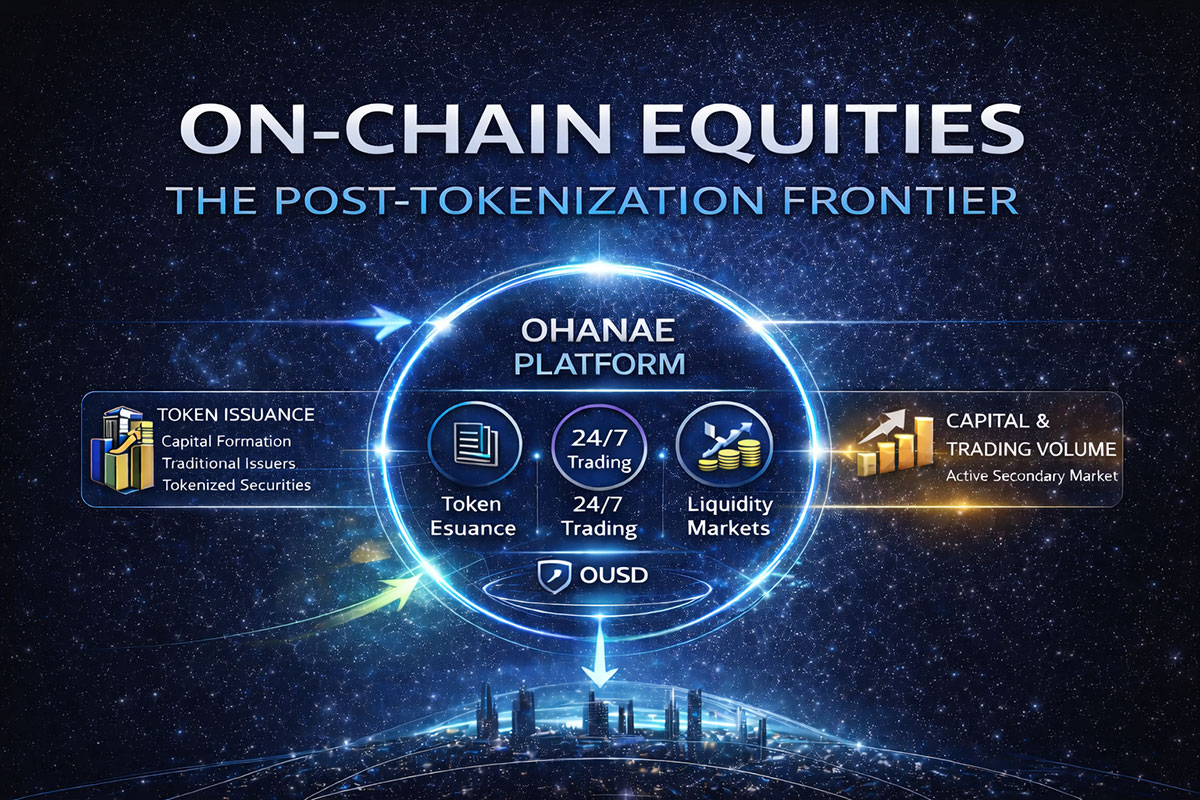
Ohanae operates as a regulated broker-dealer market infrastructure, enabling:
- Native on-chain issuance
- Dealer-principal trading
- Atomic settlement (digital cash)
- Integrated custody and transfer
- Continuous 24x7 markets
This is not:
- An exchange retrofit
- A tokenization platform
- A wrapper-based model
This is a clean-slate market architecture.
A New Role for Crypto Exchanges
Crypto exchanges play a critical role — but not the one many assume.
They are not:
- Broker-dealers
- Market operators for securities
They are:
Global distribution engines
In the emerging model:
- Exchanges provide access to users
- Regulated infrastructure operates the market
- Institutional market makers provide liquidity
This separation is essential for scalability and compliance.
What Comes Next
We are witnessing the early stages of a structural shift in capital markets.
The sequence is becoming clear:
- Tokenization within existing systems
- Emergence of native on-chain securities
- Expansion into new market infrastructure
The Defining Shift
The most important idea to understand is this:
Markets are not being upgraded. They are being rebuilt.
Final Thought
We are moving toward a world where:
- Securities are issued natively on-chain
- Markets operate continuously
- Settlement is instantaneous
- Ownership is direct and transparent
And in that world:
The winners will not be those who tokenize assets. They will be those who operate the market.
Ohanae
We do not migrate markets. We build the market that capital chooses.
NYSE, Nasdaq. Now, Ohanae.
Disclaimer
Ohanae Securities LLC is a subsidiary of Ohanae, Inc. and a member of the Financial Industry Regulatory Authority and Securities Investor Protection Corporation (FINRA/SIPC). Additional information about Ohanae Securities LLC is available on BrokerCheck.
Ohanae Securities LLC is currently in discussions with FINRA regarding the potential expansion of its business lines, which may include custody and related services for crypto asset securities. Any statements regarding the capabilities or services of Ohanae Securities LLC are subject to regulatory approval, and there can be no assurance that such approvals will be obtained.
Ohanae Securities LLC intends to operate in a manner that addresses the unique characteristics of crypto asset securities, including maintaining robust policies and procedures for custody, safeguarding of private keys, and evaluation of distributed ledger technology. The firm’s approach is designed to support crypto asset securities that may not efficiently operate within the traditional National Market System (NMS). Subject to applicable regulatory approvals, Ohanae Securities LLC may expand its activities to include additional services that may be conducted in a dealer-principal capacity, with the objective of protecting investors and maintaining market integrity.