
NYSE. Nasdaq. DTC. Ondo. Securitize. CoinList. Kraken. Binance. What Comes Next?
For the past several years, the conversation around blockchain and capital markets has been dominated by one word:
Tokenization.
Every week brings another announcement.
NYSE explores blockchain.
Nasdaq expands crypto asset initiatives.
DTCC launches tokenization infrastructure.
Ondo Finance tokenizes public securities.
Securitize enables issuer-sponsored tokenized shares.
CoinList and Superstate introduce new on-chain issuance models.
Kraken, Binance, and OKX expand tokenized securities offerings outside the United States.
At first glance, these initiatives appear highly competitive.
In reality, they are pursuing one of three distinct approaches—all focused on bringing existing securities onto blockchain.
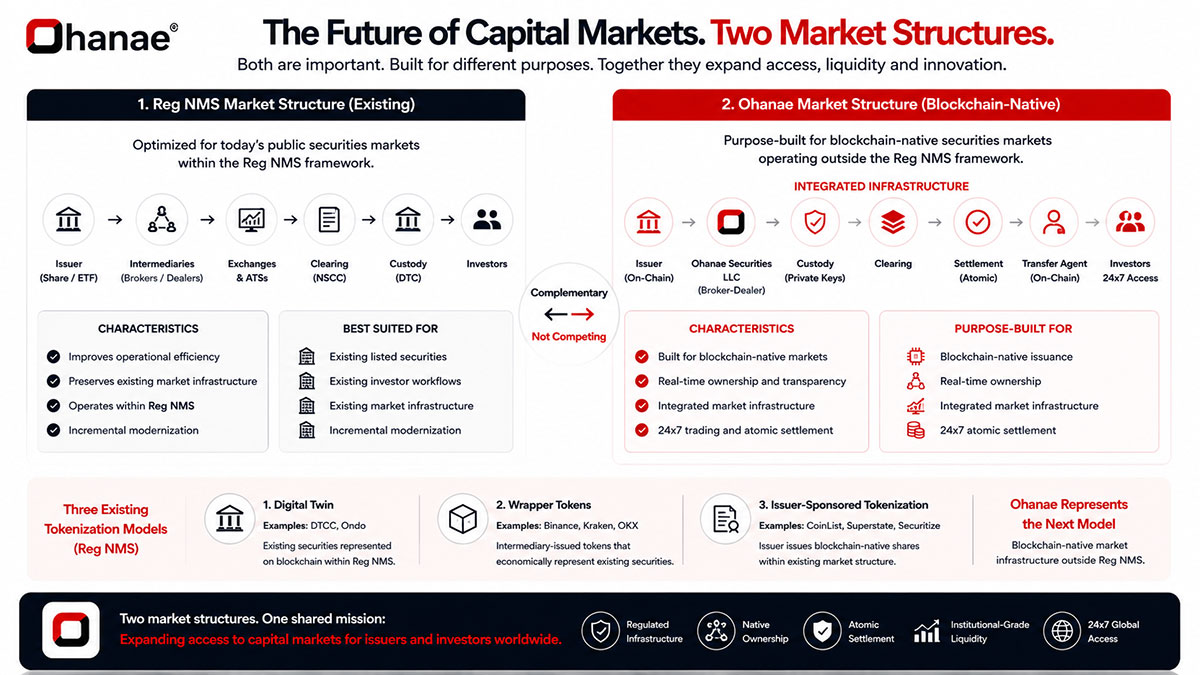
The Future of Capital Markets. Two Market Structures.
The blockchain capital markets industry is beginning to separate into two complementary market structures.
The first modernizes today's markets.
The second creates entirely new markets.
Understanding this distinction helps explain why so many companies appear to be competing while, in reality, they are solving different problems.
Three Models Modernizing Existing Markets
Although each organization uses different technology and business models, most current initiatives fit within one of three categories.
Model 1 — Digital Twin
Examples: DTCC, Ondo Finance
Existing securities remain within today's Reg NMS infrastructure while blockchain creates a digital representation of ownership or entitlement.
Benefits include:
- Improved operational efficiency
- Faster post-trade processing
- Better interoperability
- Reduced reconciliation costs
Best suited for:
- Existing listed securities
- Existing broker-dealer workflows
- Existing market infrastructure
- Incremental modernization
Model 2 — Wrapper Tokens
Examples: Binance, Kraken, OKX
An intermediary issues blockchain tokens that economically represent existing public securities.
This model improves accessibility for international investors but generally does not provide direct ownership of the underlying issuer's registered shares.
Best suited for:
- International distribution
- Crypto-native trading environments
- Existing public securities
- Incremental modernization
Model 3 — Issuer-Sponsored Tokenization
Examples: CoinList, Superstate, Securitize
The issuer participates directly by issuing blockchain-native shares while maintaining compliance through transfer agency and existing regulatory frameworks.
This represents a significant evolution beyond wrapper tokens.
Yet these securities still operate largely within today's market structure.
Best suited for:
- Existing corporate issuers
- Traditional capital formation
- Blockchain-enabled ownership
- Incremental modernization
Reg NMS Is Not Broken
The U.S. National Market System has its inefficiencies.
Settlement remains slower than blockchain technology permits.
Multiple intermediaries increase operational complexity.
Market hours remain limited.
Reconciliation continues to consume significant resources.
Yet despite these shortcomings, Reg NMS remains one of the most successful capital market structures ever created.
It provides:
- Deep institutional liquidity
- Efficient price discovery
- Strong investor protection
- Global investor confidence
- Proven regulatory oversight
No serious market participant expects NYSE, Nasdaq, or DTCC to disappear anytime soon.
Instead, the industry's objective is increasingly clear:
Modernize the existing market—not replace it.
That is precisely why organizations such as DTCC continue investing heavily in tokenization infrastructure.
A Second Market Structure Is Emerging
While modernization of existing markets will continue creating significant value, another opportunity is beginning to emerge.
Rather than asking:
"How do we tokenize Apple?"
The question becomes:
"What types of securities should be designed for blockchain from day one?"
That is an entirely different question.
Examples include:
- Reg A issuers
- S-1 issuers
- F-1 issuers
- Investment Contract Assets (ICA), if enabled by future regulation
- International issuers seeking efficient U.S. capital formation
- Blockchain-native securities designed for real-time ownership
These securities are not legacy assets migrating onto blockchain.
They are securities conceived specifically for blockchain-native capital markets.
Blockchain-Native Market Infrastructure
Once securities are designed natively for blockchain, the market infrastructure itself can also be redesigned.
Instead of adapting legacy infrastructure, blockchain becomes the system of record.
That enables capabilities such as:
- Native issuance
- Integrated custody
- Clearing
- Atomic settlement
- Transfer agency
- Dealer-principal liquidity
- 24×7 global trading
- Real-time ownership
- Programmable corporate actions
These are structural changes—not simply technological upgrades.
Why Two Market Structures Matter
The future is unlikely to be one market replacing another.
Instead, two complementary market structures are emerging.
Reg NMS markets will continue serving large, mature public companies requiring deep institutional liquidity and broad public participation.
Blockchain-native markets can enable new opportunities for Reg A issuers, S-1 and F-1 companies, Investment Contract Assets (ICA), international issuers, and other securities designed for blockchain from inception.
Each market structure is optimized for different issuers, different investors, and different use cases.
Both are likely to coexist for many years.
Market Infrastructure Matters More Than Tokenization
The first generation of blockchain innovation asked:
"How do we tokenize securities?"
The next generation is beginning to ask:
"What should capital markets look like if blockchain is the native operating system?"
Those are fundamentally different questions.
Tokenization modernizes today's markets.
Market infrastructure defines tomorrow's markets.
As blockchain capital markets continue to evolve, the greatest long-term enterprise value may not accrue to those who tokenize the most assets.
It may accrue to those who build the regulated market infrastructure upon which entirely new classes of blockchain-native securities can be issued, traded, settled, and owned.
The future of capital markets is not a choice between legacy markets and blockchain.
It is the emergence of two complementary market structures:
- One that modernizes today's markets.
- One that builds tomorrow's markets.
We believe both will succeed.
And we believe the greatest long-term opportunity lies in building the regulated infrastructure for the next generation of blockchain-native securities markets.
Confidence. That's Ohanae.