
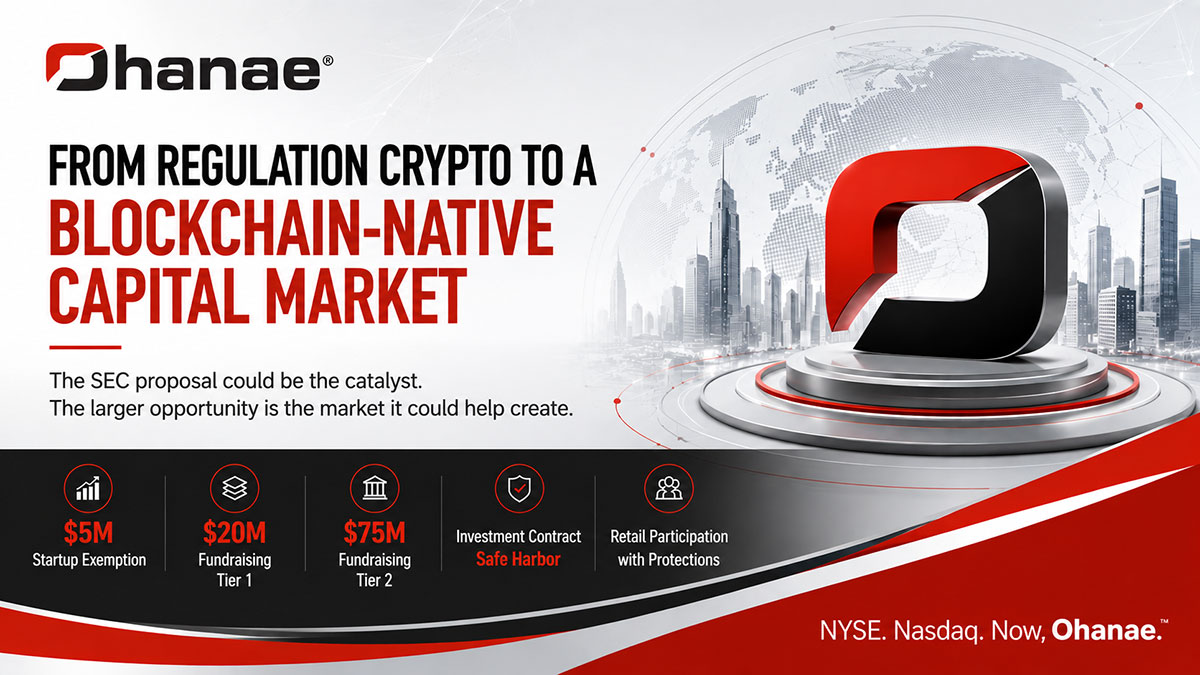
From Regulation Crypto to a Blockchain-Native Capital Market
Why the SEC's new proposal could help move tokenization from putting existing securities on-chain to creating new securities and new markets
The tokenization of financial assets is accelerating.
Much of today's activity begins with an existing security or financial asset and creates a blockchain-based representation, entitlement or record around it.
That is an important development. It could improve how traditional financial assets are distributed, recorded and transferred.
But there is another—and potentially much larger—possibility:
What happens when investment relationships, securities and markets are designed from inception for a blockchain-native capital market?
On August 18, 2026, that question became considerably more concrete.
The U.S. Securities and Exchange Commission formally proposed Regulation Crypto Assets, a purpose-built regulatory framework for certain investment contracts involving crypto assets.
The proposal includes a $5 million Startup Exemption, a Fundraising Exemption with $20 million and $75 million tiers, tailored disclosure requirements, provisions addressing secondary-market transactions and an Investment Contract Safe Harbor establishing a potential pathway through which a crypto asset could eventually cease to be subject to the investment contract with which it was originally associated.
Regulation Crypto has therefore moved from regulatory concept to actual SEC proposal.
And that development could have implications extending well beyond crypto fundraising.
It could help provide one of the missing regulatory building blocks for a blockchain-native capital market.
From Tokenization to Capital Formation
Much of today's tokenization market starts with an asset that already exists within conventional financial infrastructure:
Existing Financial Asset → Blockchain Representation
Regulation Crypto introduces the possibility of a different starting point:
Capital Formation → Blockchain-Native Investment Relationship → Regulated Market Infrastructure
The distinction matters.
Tokenizing an existing security can improve the technology through which an existing financial instrument is represented or transferred.
Regulation Crypto potentially goes further by creating new pathways through which entrepreneurs could raise capital using investment contracts involving crypto assets within the federal securities-law framework.
The SEC's proposal establishes three principal fundraising pathways.
Startup Exemption — Up to $5 Million
Eligible issuers could raise up to $5 million during a period lasting no more than four years.
This pathway is designed for relatively early-stage projects seeking capital to develop a network, application or other crypto-related undertaking.
Fundraising Exemption Tier 1 — Up to $20 Million
Eligible issuers could raise up to $20 million during a 12-month period.
Tier 1 would operate with lighter financial-statement requirements than Tier 2, including no financial-statement assurance requirement.
Fundraising Exemption Tier 2 — Up to $75 Million
Eligible issuers could raise up to $75 million during a 12-month period, subject to enhanced financial-statement, disclosure and ongoing reporting requirements.
The progression can be summarized simply:
Startup → $5M
Fundraising Tier 1 → $20M / 12 months
Fundraising Tier 2 → $75M / 12 months
For blockchain-native capital formation, that is a potentially important development.
Regulation A+ Provides an Important Reference Point
The $75 million threshold is not arbitrary.
In the proposing release, the SEC expressly notes that the proposed $75 million Tier 2 offering limit is the same limit applicable to Regulation A Tier 2.
That makes the comparison between Regulation A+ and Regulation Crypto particularly useful.
Regulation A+ established an alternative pathway through which companies can raise substantial amounts of capital without conducting a conventional registered public offering.
Regulation Crypto could bring elements of that capital-formation architecture into an environment involving crypto assets and blockchain-based networks or applications.
But there is an important difference.
Regulation Crypto must address something Regulation A was not designed to solve:
the relationship among the capital raised, the issuer's continuing managerial efforts, the crypto asset and the development of the underlying network or application.
That could make Regulation Crypto more than another securities exemption.
It could become a bridge between entrepreneurial capital formation and blockchain-native economic networks.
The Investment Contract Safe Harbor Changes the Lifecycle
Perhaps the most conceptually important component of the SEC proposal is the Investment Contract Safe Harbor.
Under the proposed framework, an investment contract associated with a crypto asset could be deemed to have ceased to exist when specified conditions have been satisfied.
Among other things, an issuer generally would need to have completed—or permanently ceased—the essential managerial efforts it represented or promised to undertake and refrain from making new promises to undertake additional essential managerial efforts.
The issuer would file a transition report explaining the basis for its determination.
If the safe harbor applies, the associated crypto asset would no longer be treated as being subject to that investment contract for purposes of the relevant Securities Act and Exchange Act definitions.
This introduces an important regulatory concept:
Capital formation and the subsequent economic life of a crypto asset do not necessarily have to remain legally inseparable forever.
Conceptually, the lifecycle could become:
Capital Formation → Development → Network/Application Functionality → Transition → Independent Crypto Asset
Not every project will necessarily complete that transition, and the final rules may differ from the proposal.
But establishing an explicit regulatory pathway for the transition is itself significant.
Capital Formation Is Only the Beginning
Creating an asset does not create a capital market.
A functioning market must also answer fundamental questions:
Who owns the asset?
Who holds it?
How do investors gain access?
Where does liquidity come from?
How are transactions cleared and settled?
Who maintains the authoritative ownership record?
The complete lifecycle extends well beyond issuance:
Capital Formation → Distribution → Ownership → Custody → Trading & Liquidity → Clearing → Atomic Settlement → Transfer Agency
This is where the distinction between tokenization and market infrastructure becomes important.
Blockchain technology can create or represent an asset.
Building a capital market around that asset requires regulated infrastructure, investors, distribution and liquidity.
Regulation Crypto potentially addresses the first part of that equation by creating new capital-formation pathways.
The market still needs everything that comes afterward.
Secondary Markets Are Part of the Proposal
This is another reason the full Regulation Crypto proposal is important.
The SEC is not considering capital formation entirely in isolation.
The proposal includes federal preemption of certain state securities-law registration and qualification requirements applicable to covered initial and secondary transactions.
In its economic analysis, the SEC specifically considers whether this could reduce duplicative regulatory requirements, lower costs and uncertainty, facilitate transactions across state lines and improve secondary-market liquidity.
That suggests a broader architecture:
Capital Formation → Distribution → Secondary Market → Liquidity
Regulation Crypto therefore should not be viewed solely as an issuance regulation.
It begins addressing how covered assets could function after the initial capital raise.
Why Crypto Exchanges Could Matter
If a viable regulated capital-formation pathway emerges, another question immediately follows:
How does a blockchain-native securities market reach investors?
Crypto exchanges have spent years building something extremely difficult and expensive to recreate: large communities of crypto-native users.
Their existing economic ecosystem already connects:
New Assets → Distribution → Trading → Liquidity → Community → Network Effects
Regulation Crypto could potentially introduce something new at the beginning of that sequence:
regulated investment opportunities.
This creates the possibility of connecting regulated securities infrastructure with crypto-native distribution
Where permitted under the applicable regulatory framework, interested investors could enter a regulated securities environment, complete required KYC/AML and securities onboarding, and participate in eligible investment opportunities.
The significance extends beyond an individual offering.
Once onboarded, investors become part of a verified investor population capable of participating in additional eligible blockchain-native investment opportunities.
This is how an individual capital-formation event can begin contributing to something larger:
a market.
From Infrastructure to Network Effects
Technology and regulatory authorization alone do not create markets.
Markets require four critical components:
Issuers. Distribution. Investors. Liquidity.
As participation grows, these components can reinforce one another.
More issuers create more assets.
More assets attract more investors.
More investors can support deeper liquidity.
Greater liquidity and distribution can attract additional issuers.
The resulting cycle becomes:
More Issuers → More Assets → More Investors → More Liquidity → More Distribution → More Issuers
The critical transition occurs when issuers no longer choose a blockchain-native market simply because the technology exists.
They choose it because:
the investors, liquidity, distribution and regulated infrastructure are already there.
A New Choice for Public Corporations
This leads to what may ultimately be the larger opportunity.
Regulation Crypto is specifically directed at certain investment contracts involving crypto assets. But the investor network, distribution channels, liquidity relationships and regulated infrastructure that develop around that market could ultimately have applications beyond Regulation Crypto itself.
If a blockchain-native market develops sufficient critical mass among KYC/AML-verified, crypto-savvy investors and institutional liquidity providers, established public corporations could have an economic reason to consider creating new issuer-sponsored blockchain-native classes of securities designed specifically for this investor market, subject to the applicable securities laws.
This is fundamentally different from creating a wrapper around an existing public security.
Much of today's model begins with:
Existing Public Security → Tokenized Representation
The underlying security remains anchored to traditional market infrastructure.
A blockchain-native model could instead begin with the issuer:
Public Corporation → New Issuer-Sponsored Blockchain-Native Security → Blockchain-Native Investor Market
The security would be designed from inception to be issued, owned, traded and settled natively on-chain, subject to applicable securities laws and regulatory requirements.
Importantly, this does not require the traditional securities market to disappear.
Two Capital-Market Structures Can Coexist
NYSE, Nasdaq and DTC are deeply embedded in the U.S. securities markets.
The development of blockchain-native capital markets does not require that system to disappear.
A public corporation could potentially participate in two distinct ecosystems:
Traditional Securities Market
Public Corporation
↓
Traditional Share Class
↓
NYSE / Nasdaq
↓
Reg NMS Infrastructure
↓
Traditional Investor Market
Blockchain-Native Securities Market
Public Corporation
↓
New Issuer-Sponsored Blockchain-Native Class
↓
Blockchain-Native Market Infrastructure
↓
Crypto-Savvy Investor Market
The two models could coexist and serve different securities and investor populations.
The future of capital markets therefore does not necessarily have to be a choice between traditional infrastructure and blockchain-native infrastructure.
Both could exist simultaneously.
Where Ohanae Fits
Ohanae has been building regulated infrastructure around this emerging market architecture.
Our FINRA-member subsidiary, Ohanae Securities LLC, has received authorization to expand its business activities to include custody, clearing, settlement and carrying of crypto asset securities.
Ohanae, Inc. is an SEC-registered transfer agent.
Together with the Ohanae platform, these capabilities are designed to support the lifecycle of blockchain-native securities across capital formation, investor onboarding, ownership, custody, trading and liquidity, clearing, atomic settlement and transfer agency.
But infrastructure is only the foundation.
Markets require participants.
That is the rationale behind the Ohanae Consortium.
The Consortium is being developed to connect crypto exchanges, institutional market makers, broker-dealers, financial institutions, capital-formation partners and investors around Ohanae's regulated market infrastructure.
Ohanae's objective is not to replicate every function performed by these institutions.
Our role is to provide the regulated infrastructure connecting them.
Protecting the Institutions That Build the Market
Blockchain-native infrastructure should not require broker-dealers and capital-formation partners to surrender the commercial relationships they have spent years developing.
Ohanae's Relationship Protection Infrastructure is designed around that principle.
Investors can become directly registered shareholders on the Ohanae platform, while the Originating Broker Registry preserves attribution to the capital-formation partner that originated the investor relationship.
The objective is straightforward:
Modernize the infrastructure without unnecessarily disintermediating the institutions that originate issuers, investors and capital.
Capital-formation partners can focus on what they do best—origination, advisory and raising capital—while leveraging regulated blockchain-native infrastructure rather than having to build that infrastructure themselves.
From Regulation Crypto to a Blockchain-Native Capital Market
Before August 18, Regulation Crypto was a potential regulatory catalyst.
Today, we can see the proposed architecture.
The SEC has put forward new capital-formation pathways, an explicit $75 million Tier 2 framework, tailored disclosure and reporting requirements, provisions addressing secondary markets and a potential transition mechanism through the Investment Contract Safe Harbor.
But Regulation Crypto is still only the beginning of the thesis.
The larger progression is:
Regulatory Framework
↓
Capital Formation
↓
Asset Formation
↓
Distribution
↓
KYC/AML-Verified Investor Critical Mass
↓
Institutional Liquidity
↓
Issuer Adoption
↓
Network Effects
↓
Blockchain-Native Capital Market
The long-term opportunity therefore extends beyond crypto-native projects.
Regulation Crypto could help catalyze the investor network.
The Consortium could connect distribution and liquidity.
The investor network could attract additional issuers.
And ultimately, established public corporations could have a new choice:
create issuer-sponsored blockchain-native securities specifically designed to reach a crypto-savvy investor market alongside their traditional securities.
That is the larger market Ohanae is being built to serve.
Regulation Crypto could be the catalyst. The larger opportunity is the market it could help create.
NYSE. Nasdaq. Now, Ohanae.
Primary Sources
U.S. Securities and Exchange Commission — Regulation Crypto Assets
Release Nos. 33-11434 and 34-106150
File No. S7-2026-27
August 18, 2026
SEC — Regulation Crypto Assets Proposing Release
Release No. 33-11434
SEC Commissioner Hester M. Peirce — “Filling the Regulatory Tank: Regulation Crypto Assets Proposing Release”
August 18, 2026
This article is provided for informational purposes only and does not constitute legal or investment advice, an offer to sell securities or a solicitation of an offer to purchase securities. Regulation Crypto Assets is a proposed SEC regulation and remains subject to public comment, revision and final Commission action. References to potential market developments and opportunities are forward-looking and subject to regulatory, commercial, market and execution risks.