
Abstract
Tokenization is often portrayed as a single concept, yet tokenizing real-world assets (RWA) is fundamentally different from tokenizing securities. Securities tokenization requires legal recognition of on-chain ownership, compliance with jurisdiction-specific laws, oversight by regulators and self-regulatory organizations (SEC, FINRA), and adherence to settlement, custody, and reporting rules. RWAs, by contrast, typically use blockchain as a representation layer without triggering these obligations. This blog explains why tokenized securities demand a purpose-built, compliance-native infrastructure — and why Ohanae is leading the way in modernizing capital markets with regulated, instant-settlement tokenized securities.
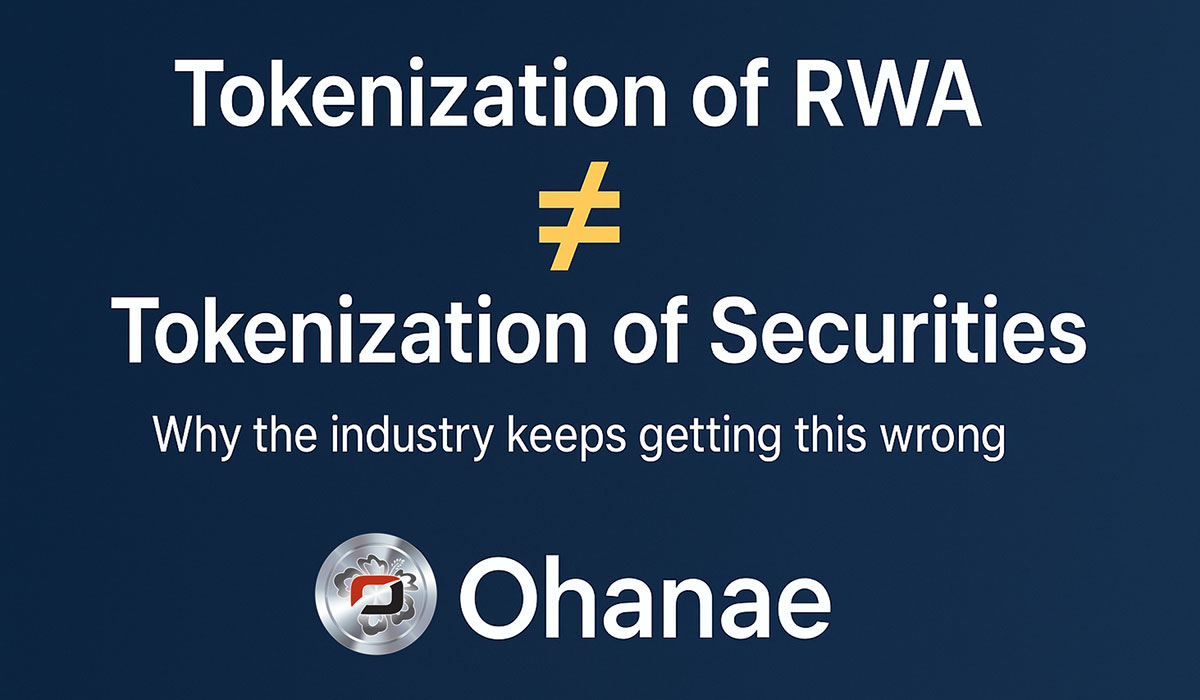
Tokenizing real-world assets (RWA) is fundamentally different from tokenizing securities — legally, operationally, and regulatorily.
Tokenization is the hottest buzzword in fintech and blockchain. Firms are piloting digital twins of real-world assets, while crypto companies wrap old ideas in new wrappers and language. Analysts predict trillions of dollars of "tokenization of RWAs."
But in the rush to adopt this narrative, one critical distinction is routinely ignored:
- They are not interchangeable concepts.
- They are not governed by the same laws.
- They do not require the same infrastructure.
And confusing them leads to flawed architectures, non-compliant platforms, and regulatory dead ends.
Let's break down the difference — and explain why the future of capital markets requires a purpose-built securities-first approach.
1. "On-Chain Ownership" Only Works When the Law Recognizes It
The most important distinction is also the most overlooked.
In securities tokenization, the blockchain can become the legal stock ledger — the single source of truth — only when a jurisdiction's corporate law explicitly allows it.
Delaware General Corporation Law (DGCL) Title 8 §224 does exactly this. It allows a corporation to maintain its stock ledger on a blockchain, making the on-chain record legally authoritative.
That means:
- The token is the security.
- The cap table lives on-chain.
- Transfers are legally binding the moment they settle.
By contrast, most RWAs — real estate, commodities, collectibles, receivables — do not have statutes granting legal recognition to blockchain records. The token is merely a representation of an off-chain asset whose true ownership rests within traditional registries and courts.
Securities tokenization can replace legacy registries. RWA tokenization almost always wraps them.
That is a monumental difference.
2. Securities Are Jurisdiction-Specific — RWAs Are Not
Securities issuance and trading are governed by some of the strictest, most fragmented regulatory regimes in the world:
- U.S.: SEC, FINRA, NYSE, Nasdaq
- EU: MiFID II, ESMA
- UK: FCA
- Singapore: MAS
- Japan: FIEA
A tokenized security remains a security — regardless of blockchain, venue, or marketing language.
This means compliance must be embedded by design, not bolted on later.
RWAs follow property law, commercial law, or contract law. Complex, yes — but nothing like the regulatory intensity of securities.
If an asset is a security, the compliance stack is mandatory.
3. Tokenized Securities Require Regulator + SRO Oversight
In the U.S., tokenized securities involve two powerful entities:
SEC — the federal regulator
Covers: issuance, custody, trading, exemptions, disclosures, transfer agents, ATS rules.
FINRA — the self-regulatory organization
Covers: broker-dealer supervision, AML, communications, audits, books & records, net capital, and more.
For carrying broker-dealers, complexity increases further:
- SEC Rule 15c3-3 (Reserve Formula & Possession/Control)
- Net Capital Rule 15c3-1
- Trade Reporting (ORF, CAT, etc)
- SEA Rules 17a-3 and 17a-4
RWAs do not trigger any of these requirements unless the structure itself qualifies as a security.
4. Tokenizing National Market System (NMS) Securities Is an Entirely Different Scale
If you tokenize NMS securities (e.g., public equities), obligations expand dramatically:
- NYSE & Nasdaq rulebooks
- Reg NMS compliance (Rules 605, 606, 611, 612)
- Market data and trade reporting
- Order protection and best execution
- Reg SCI for systems integrity
This is infrastructure-level regulation — highly technical, expensive, and unforgiving.
It has nothing in common with simple RWA tokenization.
5. Crypto Platforms Focus on Tokens; Securities Require Regulated Infrastructure
Crypto-native platforms emphasize:
- Tokens
- Smart contracts
- Wallets
- Yield dynamics
- Staking, incentives, liquidity mining
These approaches conflict with regulatory expectations for securities markets. Capital markets require:
- Custody and operational integrity
- Regulatory auditability
- Customer Identity Verification (KYC/AML)
- Risk management controls
- Compliance supervision
- Market integrity and trade reporting
- Settlement finality
This is why crypto exchanges cannot simply "add securities" — they lack the deeply integrated compliance stack required by law.
The market needs infrastructure engineered explicitly for regulated securities, not repurposed crypto tooling.
6. The Future Isn't "Crypto + Securities." It's a New Infrastructure Layer.
True securities tokenization will not look like DeFi.
It will look like a modernized, automated, compliance-native capital market stack.
The winning architecture includes:
- Blockchain-native
- Regulator-approved
- Private key custody for secure operations
- Instant (atomic) settlement
- A transition path from traditional securities to tokenized securities
- Compliance and auditability embedded at the protocol level
This isn’t "crypto meets Wall Street."
This is the next generation of capital market infrastructure.
7. The Bottom Line: Securities Tokenization Is a Different Species
To summarize:
| Category | RWA Tokenization | Securities Tokenization |
| Legal validity | Token = representation | Token = legally binding record |
| Regulation | Light/moderate | Heavy (SEC/FINRA) |
| SRO oversight | None | FINRA, NYSE, Nasdaq |
| Custody | Basic | Rule 15c3-3, 15c3-1 |
| Settlement | Flexible | Strict finality rules |
| Cross-border | Manageable | Highly complex |
| Consequences of failure | Civil disputes | Securities violations |
RWA tokenization ≠ securities tokenization.
Securities tokenization requires a regulatory-native foundation.
And only platforms built for securities can safely scale this future.
NYSE. Nasdaq. Now, Ohanae.
Ohanae is a fully custodial, cash-only platform for raising capital and trading tokenized securities — outside traditional exchanges — with instant settlement and no intermediaries.
We're building the regulated tokenized securities infrastructure the market has been waiting for:
- A public-permissioned blockchain for compliant tokenization
- Stable settlement token (OUSD) for real-time payments
- Private key custody for secure operations
- Continuous liquidity powered by our hybrid automated market-making (AMM) model
- Digital transfer agent for automated ownership tracking and corporate actions
We don't speculate. We modernize capital markets — delivering compliance, safety, and instant settlement.
Confidence. That's Ohanae.
Disclaimer
Ohanae Securities LLC is a subsidiary of Ohanae, Inc. and a member of the Financial Industry Regulatory Authority and Securities Investor Protection Corporation (FINRA/SIPC). Additional information about Ohanae Securities LLC is available on BrokerCheck.
Ohanae Securities LLC is currently in discussions with FINRA regarding the potential expansion of its business lines, which may include custody and related services for crypto asset securities. Any statements regarding the capabilities or services of Ohanae Securities LLC are subject to regulatory approval, and there can be no assurance that such approvals will be obtained.
Ohanae Securities LLC intends to operate in a manner that addresses the unique characteristics of crypto asset securities, including maintaining robust policies and procedures for custody, safeguarding of private keys, and evaluation of distributed ledger technology. The firm’s approach is designed to support crypto asset securities that may not efficiently operate within the traditional National Market System (NMS). Subject to applicable regulatory approvals, Ohanae Securities LLC may expand its activities to include additional services that may be conducted in a dealer-principal capacity, with the objective of protecting investors and maintaining market integrity.